

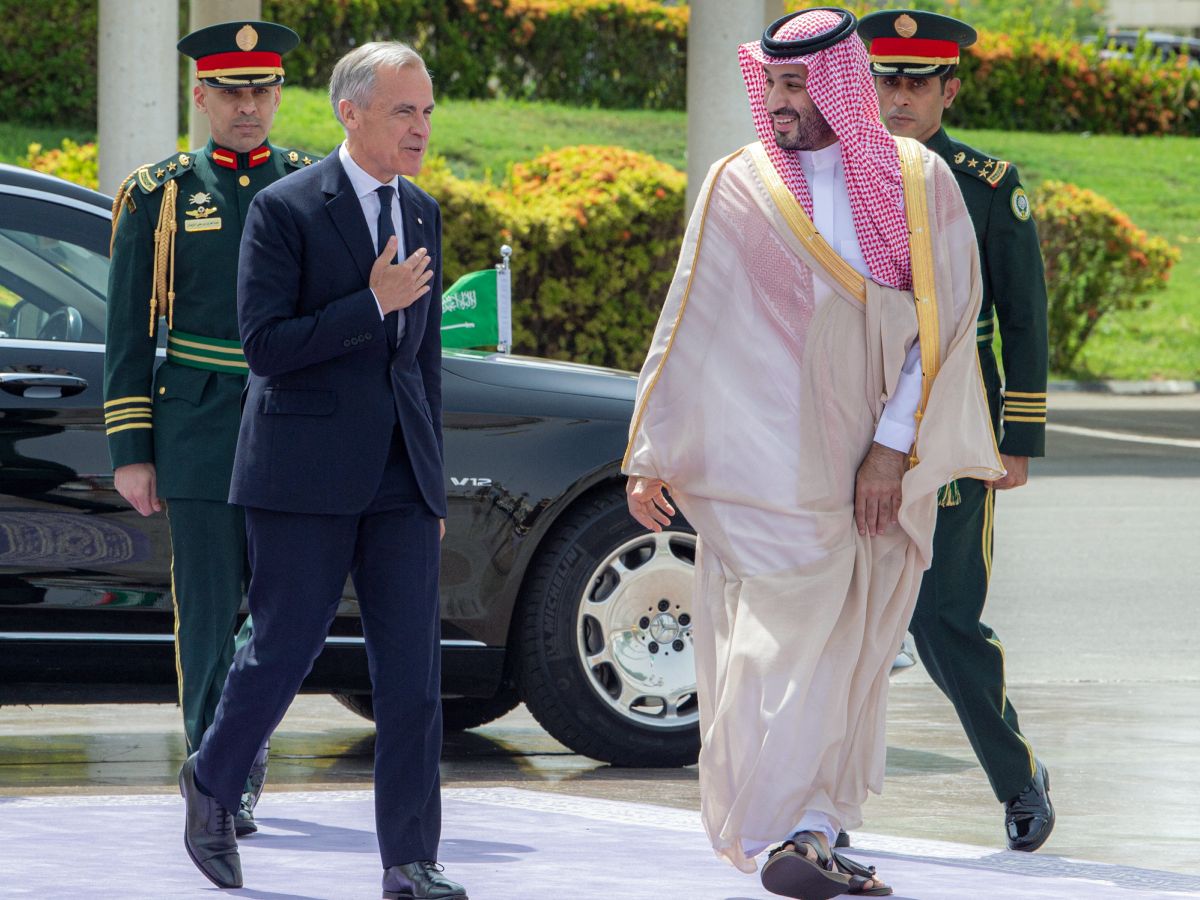
The PM's right that we shouldn't lecture from afar, but that doesn't mean we should do nothing
It was perfectly packaged, deftly marketed, efficiently delivered and widely accepted as reasonable and wise: Prime Minister Mark Carney, in Jeddah, being suave and properly indisposed to “lecturing countries from afar,” would sensibly and of necessity do business with Saudi Arabia, one of the world’s worst serial human rights abusers. Of course there would be “disagreements,” but in the newly disordered world thrust upon us by U.S. President Donald Trump, Canada’s “satisfying” but “ineffective” public scoldings of yesteryear will no longer do. Canada is calibrating new alignments with countries around the world, and that’s just how it is.
“Engagement is not endorsement. So, engaging with the country doesn’t mean that we agree with everything that a country is doing,” Carney said on July 9. His words were taken nearly verbatim from Foreign Minister Anita Anand earlier in the day.
Anand said she’d raised human rights concerns with the Saudis, quietly, adding, “It is necessary to fulfill Canadian values, to represent those values on the world stage and to bring those values to the table.” Three important realities appear to have been missed in this reading of events. The first is that there is no “disagreement” between Riyadh and Ottawa on the point that trade must take precedence over any contradictions arising from differing “values.”
The second is that there are no distinctly “Canadian” values at stake here. The values the House of Saud routinely tramples are embedded in the 1948 Universal Declaration of Human Rights. The third point is that nobody is proposing that the Saudis should be “lectured from afar,” and the tediously repeated claim that this is what former foreign affairs minister Chrystia Freeland was up to in 2018 — prompting the Saudis to blow a gasket, evict Canada’s ambassador and suspend all new trade and investment transactions — rests on a tidy little fiction.
“The Canadian position is an overt and blatant interference in the internal affairs of the Kingdom of Saudi Arabia,” the royal family’s foreign ministry declared back then. All Canada’s ambassador did was issue an anodyne statement reflecting the content of an open letter that 30 Arab feminists and human rights leaders had written to the United Nations calling for the release of several civil rights activists the Saudis had imprisoned. The Canadian Embassy merely repeated, in Arabic, a shortened version of a statement from the UN’s Office of the High Commissioner for Human Rights urging the Saudi government to “release all human rights defenders and activists who have been detained for their peaceful human rights work.”
This was the pretext the Saudis relied on to sever diplomatic ties with Canada, suspend flights to and from Toronto, order roughly 15,000 Saudi students in Canada to enrol in schools elsewhere and so on. But it had nothing to do with what Freeland or her ambassador said. It was about the chubby and pampered war criminal Prince Mohammed bin Salman throwing his newfound political weight around, making an example of Canada as a punching bag.
Rather than the rumpus arising from Canada’s interference in Saudi affairs, it was the other way around. It wasn’t just that the Saudis had long been bankrolling religious institutions in Canada to propagandize the austere Salafist wing of Islam and bully Canadian Muslims into keeping their traps shut about the excesses of the kingdom’s thousands of jet-setting “princes.” At the time, bin Salman himself was also demanding that Canada extradite the senior Saudi intelligence official Saad Aljabri, who had fled for his life and found refuge in Canada ahead of the diplomatic rupture.
Aljabri’s transgression was that his patron had been another prince, bin Salman’s rival, the deposed Mohammed bin Nayef. Bin Salman had imprisoned Aljabri’s sons, effectively taking them hostage, and his efforts to lure Aljabri back to Saudi Arabia mirrored his entreaties to the Washington Post columnist, Saudi dissident and
Source and reference
author Jamal Khashoggi, who refused to return and ended up murdered on bin Salman’s orders in the Saudi Consulate in Istanbul in October 2018. In a civil suit filed in a U.S. court in 2020, Aljabri claimed that agents from the same unit that murdered and dismembered Khashoggi with a bone saw in Istanbul had been dispatched to Canada to kill him, but the would-be assassins had been turned away by suspicious Canada customs officials at the border. This brings us to the question: what, then, if even “lecturing countries from afar” is too stern a standpoint for Canada to adopt in such matters, should Canada do? Back in 2020, responding to the disturbing claims in Aljabri’s lawsuit, Public Safety Minister Bill Blair said all the right things. It was unacceptable for foreign actors to threaten anyone living in Canada. “Canadians can be confident that our security agencies have the skills...
Read original source- Published
- Jul 16, 2026
- Updated
- Jul 16, 2026
- Source
- National Post
- Category
- Politics
- Read time
- 6 min
Key facts
Why this matters locally
This politics story matters locally because it may affect readers, businesses, commuters, families, or public services in British Columbia.
Local impact
BC Post links this item to British Columbia coverage so readers can follow related city updates, weather, traffic, events, and category news in one place.
Timeline
Source and credit
BC Post may summarize, organize, and add local context for reader clarity. Original reporting remains with the listed publisher.
Related Articles
View all Politics
Powerful pro-life ad featuring boxing legend to air during final World Cup matches
Politics
Powerful pro-life ad featuring boxing legend to air during final World Cup matches
 Politics
Vaughn Palmer: David Eby's slow and expensive step toward involuntary care
Politics
Vaughn Palmer: David Eby's slow and expensive step toward involuntary care
 Politics
Pitt Meadows to host information session for city council candidates
Politics
Pitt Meadows to host information session for city council candidates
 Politics
Corus rebuts misinformation about future of Global News in Alberta after layoffs
Politics
Corus rebuts misinformation about future of Global News in Alberta after layoffs
 Politics
‘No consequences’: East Van woman says she was targeted by hate-motivated assault
Politics
‘No consequences’: East Van woman says she was targeted by hate-motivated assault
 Politics
Hundreds of enthusiatic supporters attend Surrey Mayor Brenda Locke’s fundarising dinner
Politics
Hundreds of enthusiatic supporters attend Surrey Mayor Brenda Locke’s fundarising dinner
More Local Coverage
Latest news Business
AI Market Trends: Q2 2026 Review and Forecast
Business
AI Market Trends: Q2 2026 Review and Forecast
 Local News
Cowichan sports shorts: rugby, hockey, biking
Local News
Cowichan sports shorts: rugby, hockey, biking