

Bribing automakers to stay is not evidence of strength
Forty-two per cent of Canadian manufacturers are considering shifting production to the United States or have already done so. A survey from KPMG released in July found that 57 per cent had paused, reduced, or cancelled capital investment projects in Canada. That is a potential exodus in the making, and it could gut what is left of manufacturing in this country.
As things currently stand, capital has few national loyalties, and it has little appetite for taking part in a fight with Washington on the Canadian side of the border. Recommended Videos Pressed on those numbers, Doug Ford or Mark Carney might face an awkward news conference. Ford often invokes Ontario as a manufacturing powerhouse and says that his provincial government is overseeing “an economic powerhouse that can power jobs, investment and growth across North America.”
Carney has argued that Canada will remain an auto nation and become a global leader in next-generation auto manufacturing. It sounds reassuring, and it looks fantastic on a sticker slapped on a hard hat. If only those words were more than half true.
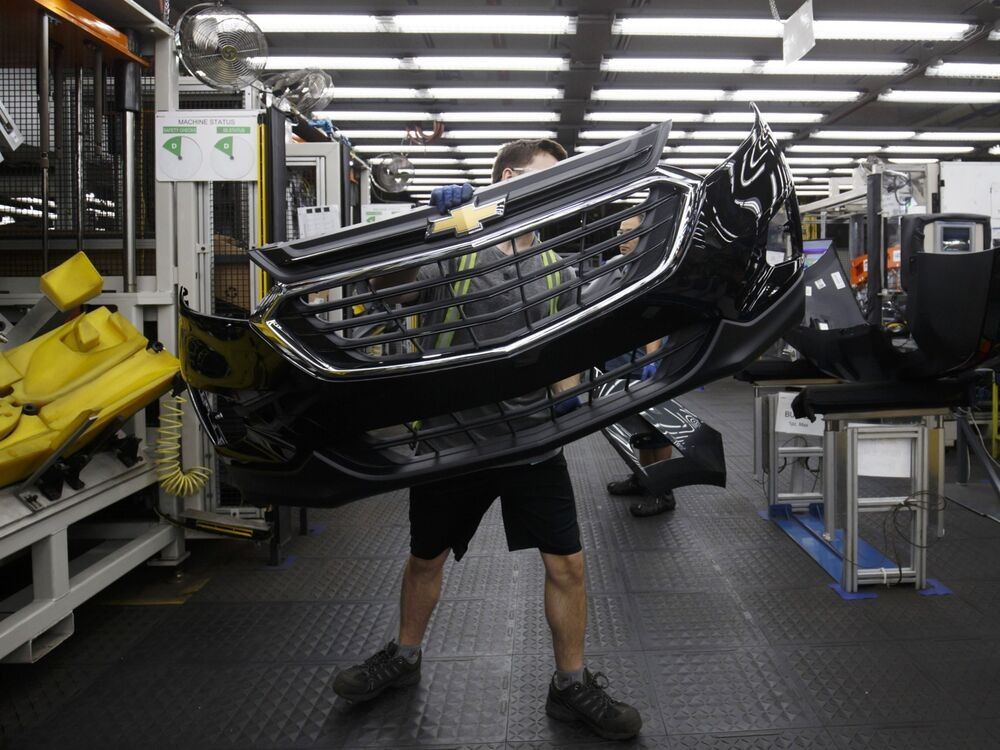
Ontario is certainly the heartland of the Canadian auto sector. In 2024, the province accounted for 84.6 percent of the sector’s national employment and 84.7 percent of its national real GDP. However, Ontario’s auto sector is not a sovereign industrial machine; it is a highly competent branch plant of an American-dominated industry.
More than 90 per cent of Canadian-made vehicles and 60 per cent of Canadian-made auto parts are exported to the U.S. The auto sector is far from being the only Canadian industry that relies on integration with the U.S. Oil and gas are also deeply reliant on American buyers, but this finally being remedied with the growing arsenal of LNG terminals and oil pipelines from Alberta to the Pacific Coast, intended to slake the appetites of a thirsty, growing Asian market. Ontario is so dependent on American multinationals and U.S. market access that Donald Trump’s tariffs threaten 125,000 direct jobs.
Put simply, Ontario can build a great deal, but it is not pulling the levers of control. Even using the term “manufacturing” risks getting lost in a cloud of undue mythology. One imagines roaring mills, dynamic firms, and world-class products.
No doubt, Ontario can make vehicles, food products, chemicals, medical goods, aerospace components, and industrial technology. But who can dispute that the romance of Ontario manufacturing still focuses on cars? In the first quarter of 2026, Ontario manufacturing sales fell by 2.1 per cent, following a 0.9 per cent decline in the previous quarter.
Sales are down 9.0 percent since mid-2023, driven largely by auto retooling and Trump’s tariffs. Motor vehicle sales fell 13.3 percent in that same quarter, and machinery output fell 4.8 percent. A healthy powerhouse can go through its ups and downs, but if Ontario’s auto sector were a man, he’d be getting backslapped by politicians while a nurse checked his pulse.
The same patient would also have a long history of being injected with expensive medications, paid for by the taxpayer, of course. The EV supply chain alone has been stuffed full of taxpayer money in a way that would outrage even the most corrupt rail barons of Confederation. Up to $52.5 billion in federal and provincial support has been tied to $46.1 billion in electric vehicle (EV) supply-chain investments.
Some of this could be defensible, as these subsidies emerged partly in response to former U.S. president Joe Biden’s industrial-policy push to reshore American auto manufacturing with subsidies of his own. Canada does not make the rules of the auto sector, and defending a strategic industry was a necessity. However, subsidies are not evidence of market strength.
Essentially bribing automakers is an unsustainable model. Ontario needs far more industrial independence and real productive capability. Regarding energy, the world’s nuclear energy industry is approaching a renaissance, and Ontario is well placed to capitalize on that.
The province has longstanding nuclear plants, a skilled nuclear workforce, and public demand for reliable power. At Darlington, Ontario Power Generation’s small modular reactor (SMR) project has a federal construction licence for one BWRX-300, a type of SMR designed for repeat deployment. If it chooses to, Ontario could use Darlington as the first step in a domestic SMR supply chain, exporting components, engineering expertise, and deployment services tied to the BWRX-300 platform.
If Canada is forced into heavier industrial policy, defence and dual-use manufacturing should be a priority. Canada’s Defence Industrial Strategy points to $180 billion in defence procurement and $290 billion in defence-related infrastructure investment over 10 years. Ontario firms can bid for more communications, aerospace, and electronics contracts, provided procurement protects Canadian control and security in sensitive industries.
Where appropriate, AI should not be shied away from. In the second quarter of 2026, 19.2 per cent of Canadian businesses reported using AI to produce goods or deliver services, more than triple the 6.1 per cent reported in the second quarter of 2024. It can be used for scheduling, tooling, robotics, quality control, and more, so long as it raises output per worker.
For all the uproar about the loss of industry and lost or outsourced factory jobs in the American Midwest, the South was one of the beneficiaries of northern industrial decline. In the United States, the Sunbelt’s growth in factories and production lines offers lessons for Ontario. The Sunbelt’s looser labour market conditions are key as well, but Ontario’s well-entrenched and politically protected unions will not stand for a copy-and-paste version of Alabama-style open-shop, deregulated labour laws.
However, if jobs continue to disappear, skilled workers may face the choice between reform that preserves their livelihoods and no livelihoods at all. Even so, the Sunbelt offers faster permitting, well-serviced industrial land, tax advantages for industry, and worker training. It is a very commercially aggressive region as well.
Ontario, and indeed Canada, should invest more heavily in different R&D, industrial sites, and productivity-enhancing infrastructure rather than relying so heavily on direct firm-specific subsidies, while modernizing its labour laws to make the province more attractive to investors. True, Justin Trudeau’s government’s R&D funding was substantial, but largely put into ineffective and ideological industries like “clean tech.” There will always be a need for R&D, whatever the failures of past governments.
Ontario manufacturing should have a future. Without it, Canada will move closer to a British-style model: a globally important financial hub in London, a large welfare state, and a thinning industrial base. Subsidized vulnerability should be neither Ontario’s model nor Canada’s.
National Post
- Published
- Jul 16, 2026
- Updated
- Jul 16, 2026
- Source
- National Post
- Category
- Technology
- Read time
- 5 min
Key facts
Why this matters locally
This technology story matters locally because it may affect readers, businesses, commuters, families, or public services in British Columbia.
Local impact
BC Post links this item to British Columbia coverage so readers can follow related city updates, weather, traffic, events, and category news in one place.
Timeline
Source and credit
BC Post may summarize, organize, and add local context for reader clarity. Original reporting remains with the listed publisher.
Related Articles
View all Technology
Transformer-manufacturing company to shut down its Chilliwack facility
Technology
Transformer-manufacturing company to shut down its Chilliwack facility
 Technology
Quebec announces plan to train more aerospace workers as demand surges
Technology
Quebec announces plan to train more aerospace workers as demand surges
 Technology
Spectro Cloud Raises $100 Million Series D to Help Customers Move AI Infrastructure Into Production Across Enterprise, Public Sector, Neocloud and Sovereign Cloud Environments
Technology
Spectro Cloud Raises $100 Million Series D to Help Customers Move AI Infrastructure Into Production Across Enterprise, Public Sector, Neocloud and Sovereign Cloud Environments
 Technology
Apple’s Lawsuit Could Choke OpenAI’s iPhone Rival Before It Even Ships
Technology
Apple’s Lawsuit Could Choke OpenAI’s iPhone Rival Before It Even Ships
 Technology
GO train users could face delays, cancellations due to ‘crew constraints’: Metrolinx
Technology
GO train users could face delays, cancellations due to ‘crew constraints’: Metrolinx
 Technology
Texting a stranger works better to fight loneliness than talking to an AI chatbot
Technology
Texting a stranger works better to fight loneliness than talking to an AI chatbot
More Local Coverage
Latest news Business
AI Market Trends: Q2 2026 Review and Forecast
Business
AI Market Trends: Q2 2026 Review and Forecast
 Politics
Powerful pro-life ad featuring boxing legend to air during final World Cup matches
Politics
Powerful pro-life ad featuring boxing legend to air during final World Cup matches