

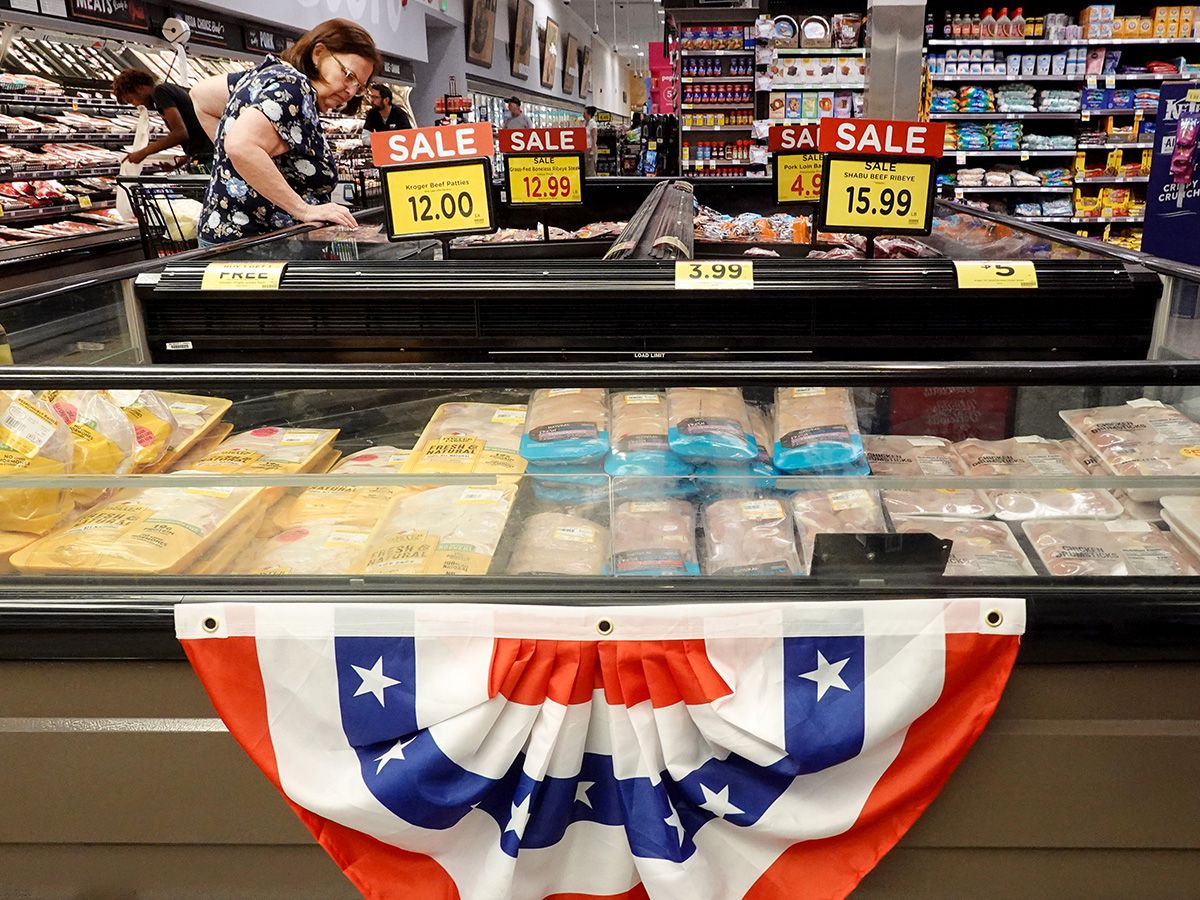
We are more like Americans than we are anyone else. Just not when we go shopping
As government expenditures go, the $8 million Ontario has reportedly dropped storing some $80 million worth of American hooch instead of selling it isn’t likely to make many waves. Most political evidence suggests you can’t go far wrong fighting back publicly against Donald Trump, or even just pretending to. Think of how far “elbows up” took Prime Minister Mark Carney, and how little he has suffered for lowering them.
You can’t deny Ontario’s LCBO and Quebec’s SAQ, two of the largest liquor purchasers in the world, have made an impact — though of course, it’s mostly in blue wine-producing states including California, Oregon, Washington and New York. American wine had a fairly strong toehold in the government-controlled Ontario market during the 2023 fiscal year: 20 per cent of sales by value, as opposed to zero. It’s not entirely clear what good does it do to annoy, say, Oregon, which hasn’t had a Republican governor in nearly 40 years, and hasn’t voted for a Republican presidential candidate since Ronald Reagan.
We’re hitting American whisky where it hurts, based on complaints out of that industry. Last week, the American Whiskey Association got behind a proposed inquiry into Canadian hooch bans and whether they violate U.S. trade law and “warrant retaliatory action.” But that’s a much less valuable tranche.
In the 2023 fiscal year, just 11 per cent of the spirits the LCBO sold by value were American; it sold nearly three times as much from Ontario, which isn’t exactly known as a hard-liquor hotbed. In 2023, Brown-Forman, the parent company of Jack Daniel’s, reported just one per cent of its net sales went to Canada . One of the worst parts about this is that much as Canadian provincial liquor boards — with the exception of Alberta’s and Saskatchewan’s — have cracked down on American hooch, it’s really not all that different in concept than the way they operated to begin with.
It’s just historically been framed as “favouring” the “domestic” industry, rather than retaliating against foreigners. (In the Trump era, Quebec’s SAQ has ramped up Canadian wine sales by volume all the way from 3.7 per cent to 4.1 percent. Compare and contrast with France: 35 per cent; Italy: 24 per cent; Spain: 20 per cent; Portugal: six per cent.
Before the boycott, the SAQ stocked nearly two-thirds more wine from the U.S. than from Canada.) Remember when we were going to eliminate interprovincial trade barriers, and spirituous beverages got a lot of attention in that regard because it’s one of the most conspicuous and easiest examples? Nah, forget it.
In fiscal 2023, the LCBO reported 99.9 per cent of its Canadian wine sales came from Ontario. In the third quarter of 2025, more than a year after Premier Doug Ford yanked American booze off the shelves and started racking up storage bills, the figure was 99.7 per cent . That has nothing to do with Trump.
This was all by design long before the White House was a gleam in Trump’s eye: Why have a provincial wholesale monopoly on liquor if you’re not going to favour spirituous beverages produced in-province, politicians of all stripes ask themselves? Much as Ford talked a decent game on interprovincial trade, privately I suspect he considers the idea of more B.C. wine on LCBO shelves a matter of cheese slipping off the cracker . In any event, all internal free trade ever offered us was incremental improvement.
What Canadian consumers should be clamouring for, as Trump’s time in office approaches its end, is vast improvement. It doesn’t take a particularly observant Canadian to wander into a midrange, midsize supermarket in an American urban area and instantly be bowled over by the selection. The egg selection, for some reason, is what always tends to flabbergast me — and the low, low, price, if you’re not fancy about it.
Then there’s the milk, and the butter and cheese (both domestic and imported) and, further up the fancy chain, things like heritage-breed poultry. Most Canadians don’t know what chicken or turkey can really taste like. It’s a (minor) national tragedy.
Good luck finding a proper heritage-breed chicken or turkey at a Canadian butcher shop. Few people are going to waste their precious quota on that. Whenever I wander around an American grocery store, gawping at the selection, I can hear Canadian voices in my head.
“Bah! Too many eggs! Who even knows what all these terms mean?”
( It’s not difficult to find out .) But I’ve always felt Canadians — Upper Canadians, especially — have this weird aversion to admitting some things are just demonstrably better than other things. “Chicken’s chicken,” we say.
“Turkey’s turkey. Butter’s butter. What’s wrong with our cheese?
Seems fine to me.” And that’s just the supply-managed sectors. I’m not much for processed snack foods, but I know the potato chips-and-related aisles at American supermarkets make some Canadians quiver in a special place.
There’s nothing wrong with diversifying our trade beyond the U.S. But for all Carney’s talk of Canada’s innate European-ness, we are more like Americans than we are anyone else. Just not when we go shopping for groceries ... or cell-phone packages, or air travel.
It needn’t be this way. We can resolve to make it otherwise, but it’s going to require more integration with post-Trump America, not less. National Post cselley@postmedia.com Chris Selley:
People are fleeing Toronto and the city doesn't seem to care Chris Selley: We can learn things from the EU without joining it
- Published
- Jul 16, 2026
- Updated
- Jul 16, 2026
- Source
- National Post
- Category
- Politics
- Read time
- 4 min
Key facts
Why this matters locally
This politics story matters locally because it may affect readers, businesses, commuters, families, or public services in British Columbia.
Local impact
BC Post links this item to British Columbia coverage so readers can follow related city updates, weather, traffic, events, and category news in one place.
Timeline
Source and credit
BC Post may summarize, organize, and add local context for reader clarity. Original reporting remains with the listed publisher.
Related Articles
View all Politics
Powerful pro-life ad featuring boxing legend to air during final World Cup matches
Politics
Powerful pro-life ad featuring boxing legend to air during final World Cup matches
 Politics
Vaughn Palmer: David Eby's slow and expensive step toward involuntary care
Politics
Vaughn Palmer: David Eby's slow and expensive step toward involuntary care
 Politics
Corus rebuts misinformation about future of Global News in Alberta after layoffs
Politics
Corus rebuts misinformation about future of Global News in Alberta after layoffs
 Politics
Pitt Meadows to host information session for city council candidates
Politics
Pitt Meadows to host information session for city council candidates
 Politics
‘No consequences’: East Van woman says she was targeted by hate-motivated assault
Politics
‘No consequences’: East Van woman says she was targeted by hate-motivated assault
 Politics
Hundreds of enthusiatic supporters attend Surrey Mayor Brenda Locke’s fundarising dinner
Politics
Hundreds of enthusiatic supporters attend Surrey Mayor Brenda Locke’s fundarising dinner
More Local Coverage
Latest news Business
AI Market Trends: Q2 2026 Review and Forecast
Business
AI Market Trends: Q2 2026 Review and Forecast
 Local News
Cowichan sports shorts: rugby, hockey, biking
Local News
Cowichan sports shorts: rugby, hockey, biking