

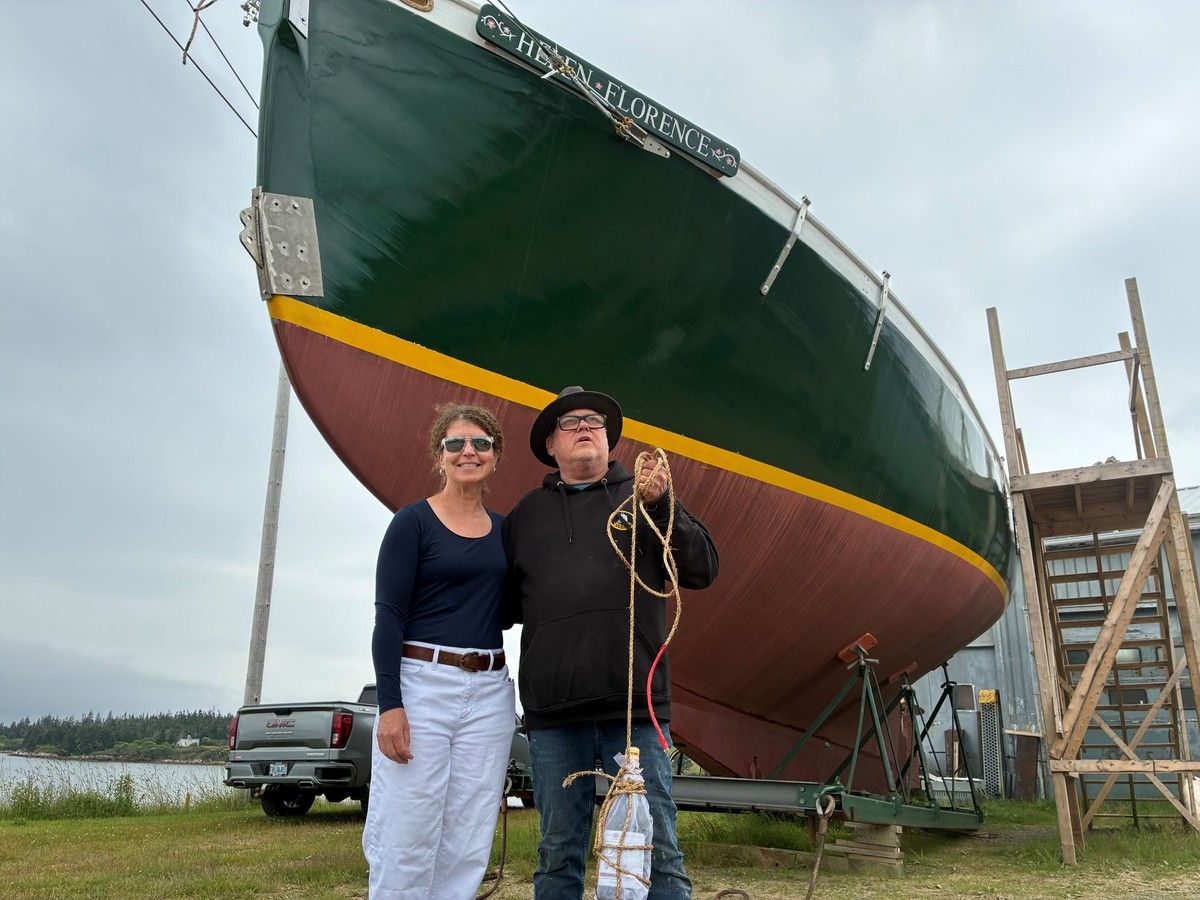
Eight years and a double lung transplant later, Munroe watched Malcolm MacEachern contorting a flatbed tractor trailer to haul the 46 foot wooden pilot schooner, named for his mother, from its perch down to the water of his youth.
A month after the white oak keel was laid, Bill Munroe was diagnosed with pulmonary fibrosis. The same disease that killed his mother four decades earlier was scarring and thickening his lung tissue. The diagnosis came with a three-to-five-year life expectancy.
Eight years and a double lung transplant later, Munroe watched Malcolm MacEachern contort a flatbed tractor-trailer to haul a 46-foot wooden pilot schooner, named for his mother, from its perch down to the water of his youth. “There’s no ‘give up,'” said Munroe. White Head showed up to cheer the Helen Florence, the first schooner launched in the Eastern Shore community in a century, down to the water.
White Head’s last schooner Munroe grew up among stories of White Head’s skippers and schooners battling gales, running rum into prohibitionist Boston States and chasing cod on the Scotian Shelf. Of a White Head ringing with the pound of caulking irons and young voices, where men raised ribs and stems from the black spruce that grew behind them. White Head’s last schooner was launched by his great uncle, Thurlow Munroe, in 1929.
She went down in 1946. It got quiet. “There were just pictures left by the time I came along,” said Munroe.
A job crewing on the Bluenose was as close to resurrecting them as he could get. Among its great canvas spread he met Tanya O’Neill from Lower Sackville. Baltimore, New York, Boston — it was 1989, and they were young and on an adventure.
Tanya Munroe became a doctor, and they moved to Truro to build a life. Three sons and life’s many responsibilities did their work putting youthful dreams aside for awhile. ‘Life happened around the boat’ Related Lunenburg Shipyard eyes 150 new jobs over five-year period through $20 million expansion How Irving Shipbuilding is tackling a coming labour shortage Warren Manthorne never managed to put dreams of wooden boats aside.
Growing up bit further down the shore in Drum Head, the descendent of a long line of boatbuilders, it was in him. The world had moved to fibreglass, steel and aluminum, but Manthorne didn’t. While raising children and working jobs that paid the bills, Manthorne and his wife, Andrea, kept building wooden boats — 27, at last count.
Hearing of a couple building a 75-foot wooden schooner in landlocked Onslow, Munroe dropped in for a visit. Like hundreds of others, he got a tour of the Lena Blanche and saw a tradition being kept alive in an unlikely place. He made an observation that the Lena Blanche shared similar lines with the Jennie F. O’Hara, a schooner Munroe’s grandfather had bought further up the shore in 1933.
Manthorne’s head snapped around. His own grandfather had built her. The plotting began.
Tanya didn’t take any convincing. “I like a challenge,” she said. So do Warren and Andrea, it seems, because along with the Lena Blanche they were soon building a Ted Brewers-designed 46-foot New England pilot schooner.
That type of vessel a century ago would race out in all weathers to get a pilot aboard freighters making for harbour. Bill and Tanya and their three teenagers would learn the art from masters and then sail her around the Maritimes. Then came Munroe’s diagnosis.
“I thought it was a death sentence,” he said. They told the boys. Appointments, decreasing lung capacity and managing the disease spread into their lives.
Bill and Tanya also had an example to set for their children. “Giving up is not an option,” said Bill. So in the Manthorne shop they learned how to steam white oak timbers, shape and fit yellow pine plank.
“Life happened around the boat,” said Tanya. Carpenter Brian Crowell joined Bill in the Helen Florence, fashioning forward bunk boards and knees. Unlike for Helen Florence, there was hope, however faint it sometimes seemed, for Bill.
In January 2023, he was flown to Halifax and from there to Toronto for a double lung transplant. In the hospital bed, struggling for breath before surgery, he talked to his family. “You say your goodbyes,” remembered Bill.
He was in ICU for eight weeks, in hospital for five months. “It was rough,” he said of recovery. He got home on May 19 of that year.
Ten days later he pushed a walker into Warren and Andrea’s barn. “The deck was on, she was an empty hull,” said Bill. And she was beautiful.
MacEachern hauled her to White Head, where Art Jardine and Don Rhynold finished her house and prepared her for the water. “Once, they were building schooners all up the shore but my generation never got a chance at that,” said Jardine, who builds houses. “So this was an opportunity.”
On Wednesday, White Head showed up to watch Tanya and Bill pour champagne over the Helen Florence’s bow. Children ran beneath the community’s first schooner in a century. Old fishermen rocked in their boots watching MacEachern grunt, curse and jackknife his flatbed tractor-trailer into seemingly impossible positions to get under the Helen Florence.
“I know where I’m at,” he hollered when one offered an unbidden suggestion. Then it was down the harbour. Black spruce masts laminated by Bill Ludwig and shaped by the Manthornes are next, along with her rigging.
The maiden cruise will be in the Bras d’Or Lake. Then everywhere. Asked for the prognosis on his recovery, Bill Munroe said, “It’s good.”
- Published
- Jul 17, 2026
- Updated
- Jul 17, 2026
- Source
- Pniatlantic
- Category
- Environment
- Read time
- 4 min
Key facts
Why this matters locally
This environment story matters locally because it may affect readers, businesses, commuters, families, or public services in British Columbia.
Local impact
BC Post links this item to British Columbia coverage so readers can follow related city updates, weather, traffic, events, and category news in one place.
Timeline
Source and credit
BC Post may summarize, organize, and add local context for reader clarity. Original reporting remains with the listed publisher.
Related Articles
View all Environment
Updated Evacuation Information for Wildfire Fort Frances 14 (July 17 2026)
Environment
Updated Evacuation Information for Wildfire Fort Frances 14 (July 17 2026)
 Environment
50-hectare wildfire burns between Clearwater and 100 Mile House
Environment
50-hectare wildfire burns between Clearwater and 100 Mile House
 Environment
A powerful movement of healing arrives at Delta’s Discovery Centre
Environment
A powerful movement of healing arrives at Delta’s Discovery Centre
 Environment
Port Coquitlam mayor launches program that removes graffiti on public property within 48 hours
Environment
Port Coquitlam mayor launches program that removes graffiti on public property within 48 hours
 Environment
2 wildfires north of Anahim Lake currently out-of-control
Environment
2 wildfires north of Anahim Lake currently out-of-control
 Environment
EU Excludes Soybean Seed from Deforestation Rules
Environment
EU Excludes Soybean Seed from Deforestation Rules
More Local Coverage
Latest news Business
AI Market Trends: Q2 2026 Review and Forecast
Business
AI Market Trends: Q2 2026 Review and Forecast
 Politics
Powerful pro-life ad featuring boxing legend to air during final World Cup matches
Politics
Powerful pro-life ad featuring boxing legend to air during final World Cup matches
 Local News
Cowichan sports shorts: rugby, hockey, biking
Local News
Cowichan sports shorts: rugby, hockey, biking