

Watches of Switzerland FY26 slides: US overtakes UK as top market
US concludes third round of strikes against Iran after Trump reinstates blockade Introduction & Market Context Watches of Switzerland Group PLC (LSE:WOSG) presented its fiscal 2026 results on July 14, 2026, highlighting a transformative year in which the United States surpassed the United Kingdom as the company’s largest market. The luxury watch and jewelry retailer reported revenue of £1,828 million, up 13% in constant currency, though margin pressures from U.S. tariffs and elevated gold prices tempered profitability gains. The company’s shares traded at $747.50 following the presentation, down slightly from the previous close but near the top of the 52-week range of $316.20 to $778.50.
The stock has delivered a 111% return over the past year, reflecting investor confidence in the company’s strategic expansion and market positioning. Executive Summary The fiscal 2026 results, covering the 53 weeks ended May 3, 2026, demonstrated broad-based growth across the company’s portfolio of luxury watch and jewelry brands. Chief Executive Officer Brian Duffy emphasized the company’s ability to execute against a complex operating backdrop, including tariff pressures, currency headwinds, and a subdued U.K. macroeconomic environment.
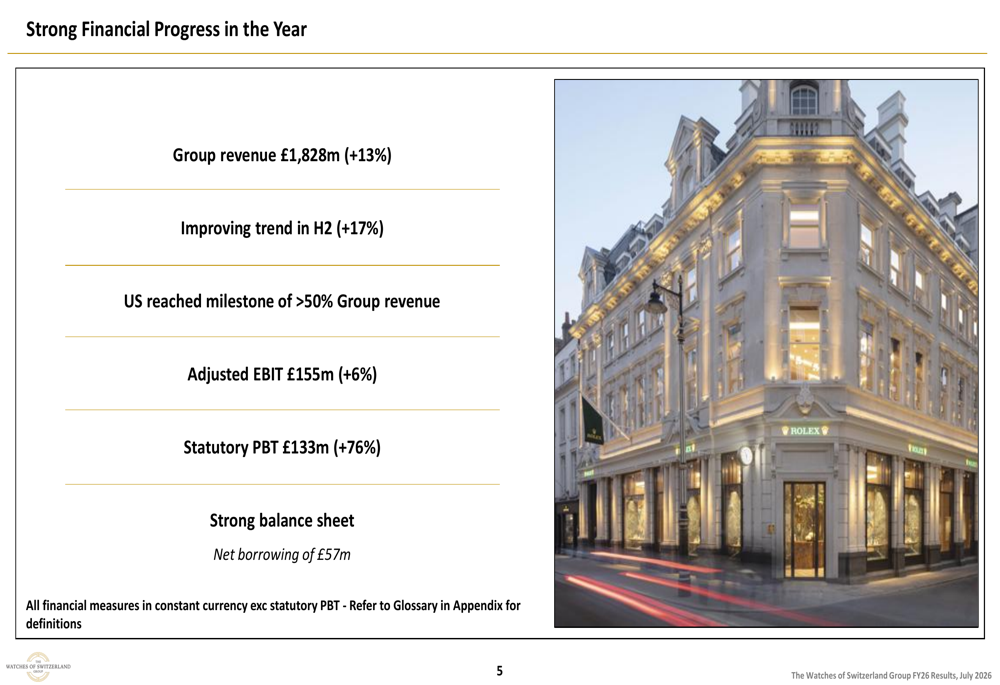
As detailed in the following financial overview, the company achieved significant revenue growth while maintaining strong cash generation. The U.S. market reached a critical milestone, accounting for more than 50% of group revenue for the first time. This geographic shift reflects both organic growth and strategic acquisitions, particularly the addition of Deutsch & Deutsch’s four Rolex-anchored showrooms in Texas.
Adjusted EBIT reached £155 million, up 6% in constant currency, though the margin contracted by 60 basis points to 8.5% due to product mix changes and tariff-related cost pressures. Detailed Financial Analysis The company’s revenue performance showed improving momentum throughout the year, with second-half growth accelerating to 17%. Statutory profit before tax surged 76% to £133 million, benefiting from operational improvements and a one-time tax credit related to the Roberto Coin jewelry business.
Adjusted earnings per share increased 9% to 45.2 pence. The following breakdown illustrates the company’s strategic initiatives across multiple growth pillars. Capital expenditure totaled £66 million in expansionary investments, supporting new showroom openings, relocations, and refurbishments.
The pre-owned watch segment emerged as a significant growth driver, with sales increasing 22% versus the prior year. The category now represents more than 8% of total business, up from less than 2% in fiscal 2019, driven largely by the rollout of Rolex Certified Pre-Owned across the U.K. portfolio. The company’s ecommerce revenue grew 21% year-over-year in constant currency, supported by the upgraded Hodinkee app, which enhances client loyalty and enables direct online purchases.
Roberto Coin luxury branded jewelry performed strongly, with sales within the Mayors network more than doubling after upgraded in-store presentations. Geographic Performance and Market Shift The most significant strategic development in fiscal 2026 was the U.S. market’s ascendance to become the company’s largest revenue contributor. As shown in the following analysis of revenue mix evolution, the geographic composition of the business has transformed dramatically over seven years.
The U.S. market grew at a compound annual growth rate of 26.4% from fiscal 2019 to fiscal 2026, while the U.K. and Europe grew at 6.3% CAGR over the same period. By fiscal 2026, the U.S. represented 51% of group revenue compared to just 24% in fiscal 2019. Equally notable is the shift in customer mix, with domestic customers now accounting for 95% of revenue versus 67% in fiscal 2019, as tourism and airport sales declined to just 5% of the total.
The company’s long-term financial trajectory demonstrates consistent execution across multiple economic cycles, as illustrated in the following comprehensive performance charts. Revenue increased from £375 million in fiscal 2015 to £1,828 million in fiscal 2026, representing a compound annual growth rate of 15.5%. Adjusted EBIT grew even faster at 29.5% CAGR over the same period, reaching £155 million.
Return on capital employed improved from 6.7% in fiscal 2015 to 18.0% in fiscal 2026, though down from a peak of 27.9% in fiscal 2022. U.S. Market Performance and Strategic Expansion The U.S. business delivered exceptional growth despite navigating tariff-driven pricing and margin changes.
Revenue reached £927 million in fiscal 2026, up 24% in constant currency from £786 million in fiscal 2025. The following detailed breakdown shows performance across all business segments. Luxury watches represented the largest category at £737 million, growing 24% in constant currency.
Luxury jewelry sales reached £50 million, up 32% in constant currency, while wholesale revenue grew 22% to £127 million. The acquisition of Deutsch & Deutsch, completed in January 2026, added strategic depth to the company’s Texas presence. As shown in the following overview, the Deutsch & Deutsch acquisition brought four highly complementary Rolex-anchored showrooms to the portfolio.
The century-old Texas luxury retailer operates showrooms in El Paso, Laredo, McAllen, and Victoria, with two locations recently undergoing significant expansion and refurbishment. The company utilized a new acquisition model in which previous owners Tad and Aladar Deutsch maintained equity stakes and remained in leadership positions, ensuring continuity and operational stability. U.K. Market Performance While the U.S. market captured headlines, the U.K. and Europe segment demonstrated solid growth in a subdued macroeconomic environment.
Revenue increased 4% to £901 million, with improving trends throughout the year across both watches and jewelry categories. Luxury watches contributed £770 million, up 4% versus fiscal 2025, while luxury jewelry grew 12% to £71 million. The company continued investing in its showroom estate, with notable openings including Northern Goldsmiths Newcastle in July 2025 and Mappin & Webb Birmingham in December 2025.
The Rolex Old Bond Street flagship store, which opened in the prior fiscal year, completed its first full year of operation with strong results. As illustrated in the following interior photographs, the store delivered exceptional customer and employee satisfaction metrics. The flagship location achieved a Net Promoter Score of 93.6% and colleague satisfaction of 97%, supported by external training expertise from the AHA Group.
The store reaffirmed Old Bond Street’s status as a leading destination for global luxury retail. Financial Position and Cash Generation The company’s balance sheet remained strong throughout fiscal 2026, with net borrowing of just £57 million representing 0.3 times net debt to adjusted EBITDA.
The following key performance indicators summarize the company’s financial health. Free cash flow reached £162 million with 80% conversion, demonstrating the business’s strong cash-generative characteristics. Return on capital employed stood at 18.0%, reflecting efficient deployment of capital across showroom investments and acquisitions.
The income statement for fiscal 2026 shows the interplay between revenue growth and margin pressures, as detailed in the following comprehensive breakdown. Revenue increased 11% on a reported basis to £1,828 million, while net margin percentage declined 70 basis points to 35.6% due to reduced brand margin from U.S. tariffs and product mix. Adjusted EBIT grew 3% on a reported basis to £155 million, with the margin contracting 60 basis points to 8.5%.
The effective tax rate improved to 26.7% from 27.8%, benefiting from a one-time tax credit on Roberto Coin. Adjusted earnings per share increased 9% to 45.2 pence. The drivers of revenue growth are illustrated in the following waterfall analysis, which separates geographic and currency effects.
On a constant currency basis, group revenue increased 13% to £1,872 million, driven by U.S. retail growth of £168 million (+25%), U.K. and Europe growth of £35 million (+4%), and wholesale growth of £23 million (+22%). Foreign exchange movements reduced reported revenue by £44 million, resulting in final reported growth of 11% to £1,828 million. Profitability trends reflected both operational leverage and margin headwinds, as shown in the following adjusted EBIT analysis.
Adjusted EBIT increased 6% in constant currency to £159.3 million before a £4.5 million foreign exchange headwind reduced reported growth to 3%. The U.S. retail segment contributed £13.8 million of incremental EBIT, while the U.K. and Europe segment declined £4.1 million due to limited leverage on fixed costs and product mix pressures. Adjusted EBIT margin contracted across all segments, with U.S. retail at 8.8% (down from 9.0%), U.K. and Europe at 7.3% (down from 8.1%), and Roberto Coin wholesale at 19.7% (down from 21.8%) due to increased marketing spend.
The balance sheet summary demonstrates ongoing financial strength despite growth investments, as detailed below. Goodwill and intangibles increased 5% to £320 million, reflecting £39 million spent on acquisitions, primarily Deutsch & Deutsch. Property, plant and equipment grew 13% to £217 million, including £66 million of expansionary capital expenditure.
Inventory levels increased just 2% to £458 million despite the acquisition, as underlying stock turns continued to improve. Net debt improved to £57 million from £96 million in the prior year, reflecting strong cash flow generation. Cash flow performance highlighted the business’s ability to convert earnings into cash, as shown in the following detailed statement.
Adjusted EBITDA of £202 million, combined with working capital improvements and lower tax payments, generated £176 million in operating cash flow, up 57% from the prior year. After maintenance capital expenditure and interest, free cash flow reached £162 million with 80% conversion. The company deployed £66 million in expansionary capital expenditure, £39 million on acquisitions, and £14 million on share repurchases, resulting in net cash flow of £38 million.
Forward-Looking Statements Management provided fiscal 2027 guidance reflecting continued growth with margin recovery. As outlined in the following table, the company expects revenue growth of 5% to 10% in constant currency and adjusted EBIT margin expansion of 40 to 80 basis points. The guidance assumes a 52-week fiscal year (versus 53 weeks in fiscal 2026), visibility of supply for key brands, and reflects confirmed showroom projects.
Capital expenditure is expected to range between £60 million and £70 million. The guidance excludes uncommitted capital projects and potential acquisitions. Chief Financial Officer Anders Romberg noted that the margin outlook should improve in fiscal 2027, helped by the absence of a one-time £3.5 million bad debt charge tied to Roberto Coin and by operating leverage.
He quantified currency sensitivity, stating that a $0.05 movement in the dollar impacts approximately $30 million in sales and $4.5 million in EBIT. The company’s closing summary emphasized strong execution and strategic progress, as highlighted below. Management reported encouraging trading in the first 10 weeks of fiscal 2027, with the U.S. remaining strong and the U.K. showing more normalized conditions.
The company expressed confidence in delivering another year of strong revenue growth and a return to EBIT margin expansion, supported by a robust return on investment pipeline with good conversion rates. Strategic Initiatives Beyond geographic expansion, the company advanced several strategic growth pillars during fiscal 2026. The pre-owned watch category emerged as a meaningful contributor, with the Rolex Certified Pre-Owned program continuing its rollout across the U.K. portfolio.
Management indicated that every U.S. agency now carries Rolex CPO, while U.K. expansion will accelerate as stores undergo redesigns. The Roberto Coin luxury jewelry brand demonstrated strong performance in both retail and wholesale channels. Sales within the Mayors network more than doubled following upgraded in-store presentations, and three Roberto Coin mono-brand boutiques opened in the U.S. during the fiscal year.
Management reported no customer churn related to the bad debt charge, indicating the brand’s underlying strength. Digital commerce initiatives centered on the Hodinkee platform, which launched an upgraded app to enhance client loyalty and enable direct online purchases from Watches of Switzerland showrooms. The company views Hodinkee as a long-term investment that should contribute more meaningfully in fiscal 2027 and beyond.
Analyst Perspectives During the question-and-answer session, analysts focused on current trading momentum, pre-owned growth trajectories, margin recovery drivers, and brand pricing dynamics. UBS inquired whether trading trends were tracking toward the top end of guidance, while Goldman Sachs sought details on the certified pre-owned business and margin expansion catalysts. Management indicated the company was slightly ahead of first-quarter assumptions but cautioned against reading too much into early trends.
The U.S. market remained strong, while U.K. conditions had normalized. RBC questioned the treatment of the Roberto Coin bad debt charge, with management confirming the £3.5 million write-off was included in adjusted EBIT rather than exceptional items, meaning the reported margin understated the underlying run rate. Other questions addressed Roberto Coin customer retention, Rolex pricing assumptions, and the potential impact of Rolex’s new production facility in Switzerland.
Management stated that pricing assumptions were not built into guidance and that any supply benefit from expanded Rolex production capacity remained too speculative to include in forecasts. The company’s market capitalization of $2.34 billion reflects investor confidence in the multi-year growth strategy, though the modest stock price movement following the presentation suggests much of the positive outlook was already incorporated into valuations. With shares trading near their 52-week high, the focus shifts to execution against fiscal 2027 guidance and the company’s ability to expand margins while maintaining revenue momentum across both the U.S. and U.K. markets.
Full presentation: This article was generated with the support of AI and reviewed by an editor. For more information see our T&C.
- Published
- Jul 14, 2026
- Updated
- Jul 14, 2026
- Source
- Investing Canada
- Category
- Politics
- Read time
- 10 min
Key facts
Why this matters locally
This politics story matters locally because it may affect readers, businesses, commuters, families, or public services in British Columbia.
Local impact
BC Post links this item to British Columbia coverage so readers can follow related city updates, weather, traffic, events, and category news in one place.
Timeline
Source and credit
BC Post may summarize, organize, and add local context for reader clarity. Original reporting remains with the listed publisher.
Related Articles
View all Politics
Powerful pro-life ad featuring boxing legend to air during final World Cup matches
Politics
Powerful pro-life ad featuring boxing legend to air during final World Cup matches
 Politics
Traditional Catholic response to Cupich’s suicide distortion
Politics
Traditional Catholic response to Cupich’s suicide distortion
 Politics
Vaughn Palmer: David Eby's slow and expensive step toward involuntary care
Politics
Vaughn Palmer: David Eby's slow and expensive step toward involuntary care
 Politics
Corus rebuts misinformation about future of Global News in Alberta after layoffs
Politics
Corus rebuts misinformation about future of Global News in Alberta after layoffs
 Politics
Bell: Bike lane clash in Edmonton, is Calgary next in line for a fight?
Politics
Bell: Bike lane clash in Edmonton, is Calgary next in line for a fight?
 Politics
‘No consequences’: East Van woman says she was targeted by hate-motivated assault
Politics
‘No consequences’: East Van woman says she was targeted by hate-motivated assault
More Local Coverage
Latest news Business
AI Market Trends: Q2 2026 Review and Forecast
Business
AI Market Trends: Q2 2026 Review and Forecast
 Top
‘Entire city’ asked to help search for missing 11-year-old Parker: Calgary police
Top
‘Entire city’ asked to help search for missing 11-year-old Parker: Calgary police
 Local News
Cowichan sports shorts: rugby, hockey, biking
Local News
Cowichan sports shorts: rugby, hockey, biking