

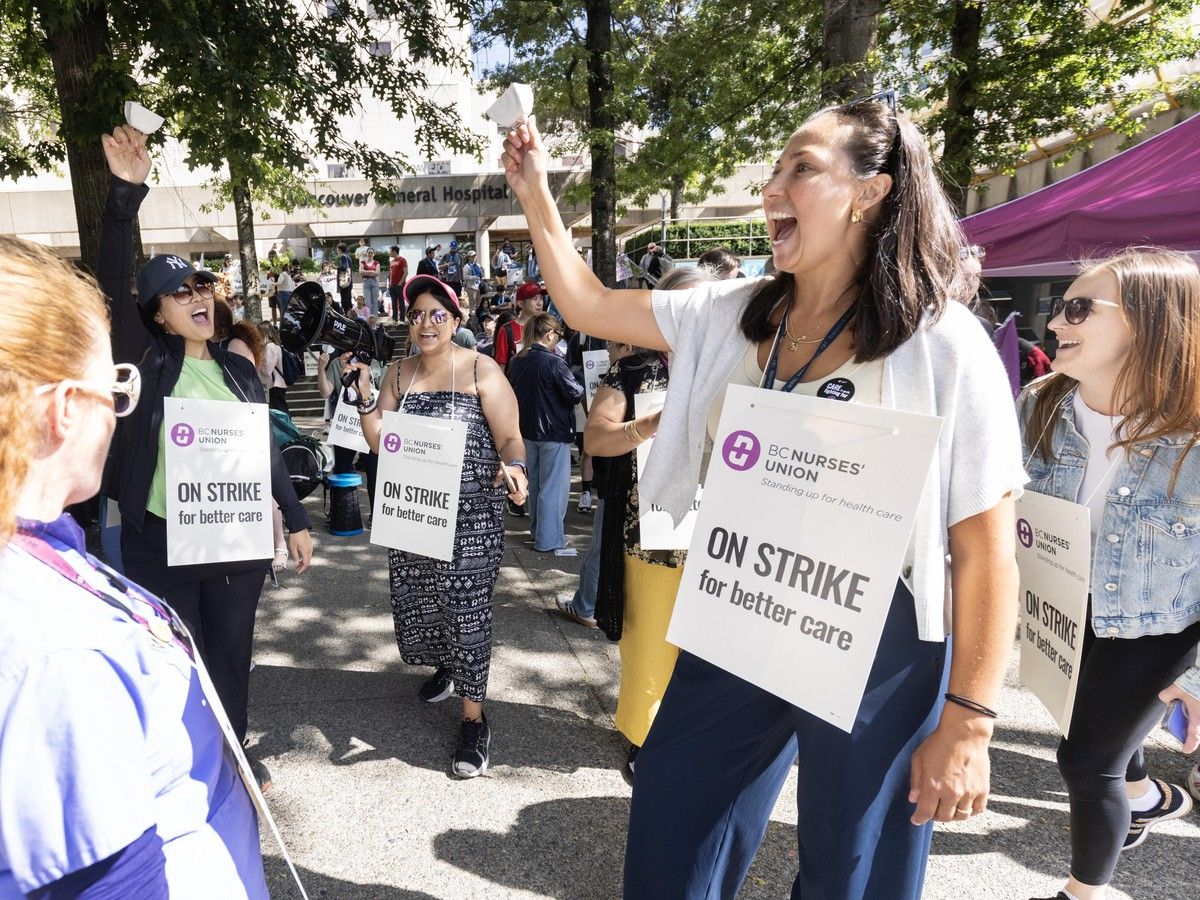
Opinion: Mediators Vince Ready and Amanda Rogers are the go-too for tough talks, but can even they close a multi-billion-dollar pay divide?
VICTORIA — Nurses Union President Adriane Gear reduced the prospects for settlement to a single sentence when responding to the government appointment of special mediators in the dispute. “We are cautiously optimistic that there’s been this appointment. However, it does give me pause that there’s not been any word on expanding the mandate so that we can get a deal,” she said Sunday.
On Monday, the union called off its planned picketing as a sign of good faith as the mediation talks began. Expanding the mandate: Shorthand for the nurses wanting more — much more — than the NDP cabinet-approved “balanced” mandate in the current round of public sector bargaining. Gear and her union have not made public the demand they presented to government negotiators last week.
But I understand it was more than double the 12 per cent over four years that has already been accepted by unions representing about three quarters of the workforce in the provincial public sector. No wonder Gear declared an impasse in the talks after the government refused to budge on the mandate. No wonder the government appointed special mediators Vince Ready and Amanda Rogers just eight days into the strike.
Last year, the government let the BCGEU strike drag on for seven weeks before appointing the same duo to sort it out. Despite their essential-services designation, the nurses, with their critical role in delivering health services, have more leverage than the workers in central government, whose biggest pressure point was the liquor distribution warehouse. A larger factor this time was the irreconcilable gap at the bargaining table.
The New Democrats and the nurses were so far apart, there was zero chance of progress in face-to-face negotiations. Even if the New Democrats wanted to violate their own mandate for a group that the premier himself described as “the most beloved among all the professions,” they could not do so without springing a trap on themselves with massive financial consequences. Unions that settle early in a bargaining round often secure an insurance clause that says they will get an equivalent top up if government exceeds its own mandate in later settlements.
Those “me-too” clauses used to allow some manoeuvring room for side deals. In the last bargaining round before this one, the government used the leeway to provide the nurses with several percentage points more than other public sector unions. The other unions settled in the range of 14 per cent over three years.
The nurses, by one internal reckoning, got more like 18 or 19 per cent all in. This time around, the me-too clauses are tighter, leaving no room for fudging. The government estimates that a one-point increase in wages and benefits across the entire public sector costs out at about $440 million a year.
Supposing the nurses were to get 25 per cent over four years — and I believe the union demanded more than that last week — the additional 13 points, when extended across the public sector, would cost $5 billion to $6 billion. The premier was asked Friday “how much of a miracle” could the special mediators work out, given that the two sides were far apart on salary plus the fiscal constraints on the province. Eby was not inclined to bargain publicly within those parameters, even in the same news conferences where he described the nursing profession as beloved.
Yet at the news conference, the premier hinted at a couple of areas for making progress outside the wage-and-benefit mandate. “The job action by nurses to draw attention to their concerns about conditions of work, around safety — those are real,” said Eby. “Our government has been making sure that there’s an enforceable ratio of patients per nurse so that a nurse doesn’t feel that patients aren’t getting the care that they need.
(There’s) work around improving security, including pilots related to security screening and new relational security guards.” The government might put more funding into improving nurse-to-patient ratios. It could staff emergency wards with armed protective services guards, like those at the legislature.
Gear herself mentioned another possibility for improvement: “What is really missing is a strategy that nurses can buy into in terms of retention and recruitment.” Another possibility is the one that the Ready-Rogers duo adopted in settling the BCGEU dispute. Going in, New Democrats were still pursuing a two-year deal.
The mediators boosted the term to four years. A longer-term contract for the nurses alone? More funding for improved nurse-to-patient ratios, recruitment, retention and safety?
Those possibilities don’t sound all that likely with the two sides so far apart on the biggest ticket items of wages and benefits. But if mediation fails, then the government is considering binding arbitration or recalling the legislature to impose a settlement. The New Democrats don’t want to do either, which might provide them with the impetus to engage in some creative deal-making of their own with the help of the mediators.
- Published
- Jul 13, 2026
- Updated
- Jul 13, 2026
- Source
- Vancouver Sun
- Category
- Politics
- Read time
- 4 min
Key facts
Why this matters locally
This politics story matters locally because it may affect readers, businesses, commuters, families, or public services in British Columbia.
Local impact
BC Post links this item to British Columbia coverage so readers can follow related city updates, weather, traffic, events, and category news in one place.
Timeline
Source and credit
BC Post may summarize, organize, and add local context for reader clarity. Original reporting remains with the listed publisher.
Related Articles
View all Politics
Powerful pro-life ad featuring boxing legend to air during final World Cup matches
Politics
Powerful pro-life ad featuring boxing legend to air during final World Cup matches
 Politics
Traditional Catholic response to Cupich’s suicide distortion
Politics
Traditional Catholic response to Cupich’s suicide distortion
 Politics
Vaughn Palmer: David Eby's slow and expensive step toward involuntary care
Politics
Vaughn Palmer: David Eby's slow and expensive step toward involuntary care
 Politics
Corus rebuts misinformation about future of Global News in Alberta after layoffs
Politics
Corus rebuts misinformation about future of Global News in Alberta after layoffs
 Politics
Bell: Bike lane clash in Edmonton, is Calgary next in line for a fight?
Politics
Bell: Bike lane clash in Edmonton, is Calgary next in line for a fight?
 Politics
‘No consequences’: East Van woman says she was targeted by hate-motivated assault
Politics
‘No consequences’: East Van woman says she was targeted by hate-motivated assault
More Local Coverage
Latest news Business
AI Market Trends: Q2 2026 Review and Forecast
Business
AI Market Trends: Q2 2026 Review and Forecast
 Top
‘Entire city’ asked to help search for missing 11-year-old Parker: Calgary police
Top
‘Entire city’ asked to help search for missing 11-year-old Parker: Calgary police
 Local News
Cowichan sports shorts: rugby, hockey, biking
Local News
Cowichan sports shorts: rugby, hockey, biking