


So far this year Alberta has experienced an unpredictable summer with heavy rain, heat, and tornadoes – more so than usual.
So far this year Alberta has experienced an unpredictable summer with heavy rain, heat, and tornadoes – more so than usual. On average, Alberta sees about 11 tornadoes a year between June and August, with the season peaking in July. As of mid-July, there have been 24 confirmed tornadoes throughout the province in 2026.
Bobby Sekhon, a meteorologist with Environment and Climate Change Canada, said this summer has seen repeated cycles of heavy moisture, heat, cold fronts or troughs, and jet streams – the ingredients for a perfect storm. “It’s astonishing to see those weather patterns set up over and over again,” Sekhon told CTV News Edmonton. A recent tornado that touched down near the Alberta-Saskatchewan border destroyed a campground at the Dillberry Lake Provincial Park and injured five people, three of which were sent to hospital.
That tornado reached a level 2 on the Enhanced Fujita (EF) scale, a measuring system used to rate tornado intensity based on the wind speed, damage indicators and degrees of damage. To put that into perspective, the 1987 Edmonton tornado, also referred to as Black Friday, reached 4 on the Fujita scale. Twenty-seven people died and more than 300 were injured.
The Fujita scale was revised and implemented in Canada in 2013 as the EF scale. Despite the Dillberry tornado rating being relatively low, Dave Sills, director of the Northern Tornadoes Project at Western University, said weak tornadoes can still cause a lot of damage. “Even the weakest tornadoes ... if you just happen to be in the wrong place at the wrong time, can be deadly,” said Sills.
“It just gets worse as you go up in intensity. You certainly don’t want to see an EF5 tornado.” Western University’s tornado dashboard has reported 61 total tornadoes across the country so far this year.
Those in Alberta make up more than a third of that. The only F5 tornado recorded in Canadian history was in 2007 in Elie, Man. There were no casualties, but homes were reportedly ripped from their foundation.
Rider on the storm Jason Whiting was at Sandy Beach Provincial Park just north of Lloydminster when he received an alert of a funnel cloud that had touched down nearby. He decided to jump in his truck, camera in tow, to check it out. “You never know what you might find,” said Whiting, adding that he isn’t a storm chaser per se, but finds pleasure in taking photos of such opportunities.
Whiting drove to Jumbo Hill, a viewpoint that looks over the North Saskatchewan River near Tulliby Lake, where the tornado touched down. “Just as you peeked over that hill, all of a sudden, there it was,” he said. “It was a unique perspective because we were a little bit higher than the tornado in some ways, looking down at it.”
Several structures were damaged in the Tulliby Lake tornado but no injuries were reported. Whiting has also noticed the frequency of tornadoes this year. “It’s been a very unique summer here,” he said.
“Tornadoes are such a phenomenon. You don’t see them very often, and maybe, in some ways, you don’t hope to see them ... but they’re such a unique form of nature ...
there’s just such intense power to these things.” Predicting tornadoes unpredictable The erratic nature of tornadoes provides a challenge in predicting such weather events. However, with the right conditions, meteorologists can make conclusions on the possibility of a funnel cloud.
“With tornadoes, our prediction capability is not that far in the future,” said Sekhon. “Oftentimes, it’s a matter of minutes when a cell shows up on our radar in a favourable area for tornadoes ... as soon as we see some signatures, that gives us confidence that this could be hitting the ground and it could be a tornado.” A signature, or tornado vortex signature, refers to a pattern of rotation seen on radar indicating the high probability of a tornado.
“It’s a really short, tight timeline, and that’s why it’s so important for everybody to stay tuned (to forecasts) because all this happens, sometimes, in a matter of minutes.” Individuals can stay in the loop by subscribing to Alberta Emergency Alerts . With files from CTV News Edmonton’s Miriam Valdes-Carletti
- Published
- Jul 13, 2026
- Updated
- Jul 13, 2026
- Source
- Ctv News
- Category
- Environment
- Read time
- 3 min
Key facts
Why this matters locally
This environment story matters locally because it may affect readers, businesses, commuters, families, or public services in British Columbia.
Local impact
BC Post links this item to British Columbia coverage so readers can follow related city updates, weather, traffic, events, and category news in one place.
Timeline
Source and credit
BC Post may summarize, organize, and add local context for reader clarity. Original reporting remains with the listed publisher.
Related Articles
View all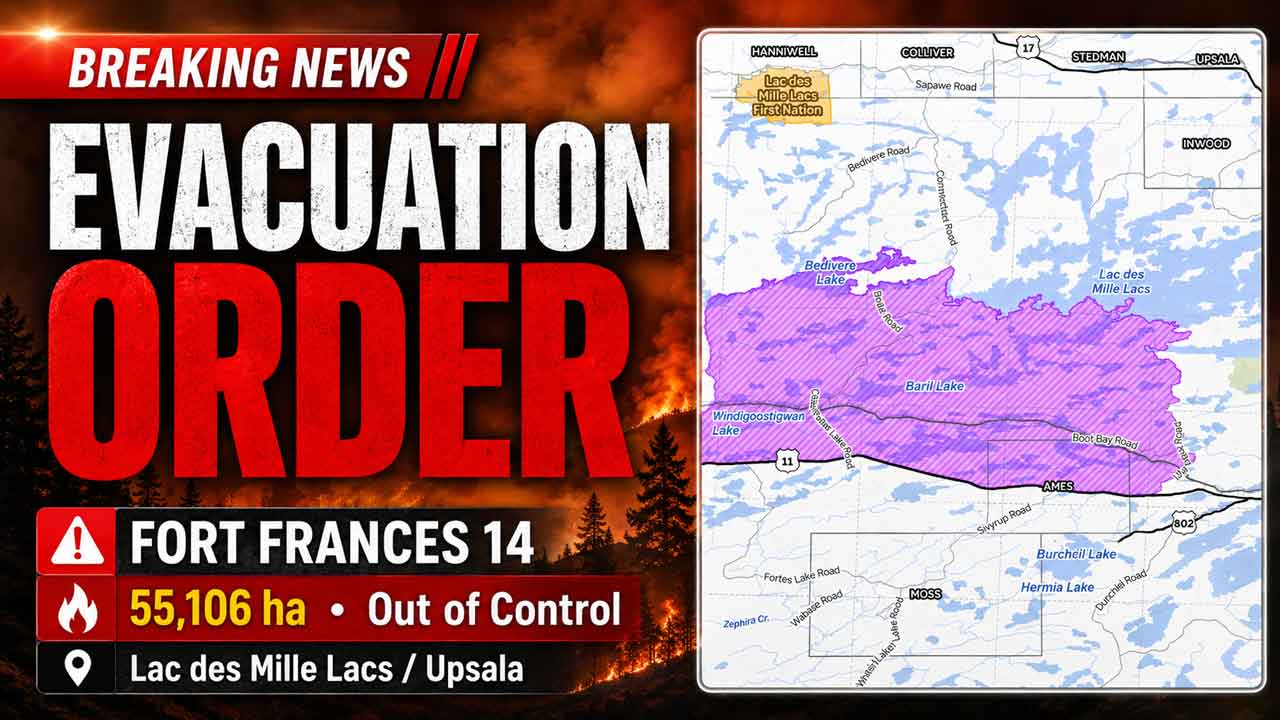 Environment
Updated Evacuation Information for Wildfire Fort Frances 14 (July 17 2026)
Environment
Updated Evacuation Information for Wildfire Fort Frances 14 (July 17 2026)
 Environment
50-hectare wildfire burns between Clearwater and 100 Mile House
Environment
50-hectare wildfire burns between Clearwater and 100 Mile House
 Environment
A powerful movement of healing arrives at Delta’s Discovery Centre
Environment
A powerful movement of healing arrives at Delta’s Discovery Centre
 Environment
Port Coquitlam mayor launches program that removes graffiti on public property within 48 hours
Environment
Port Coquitlam mayor launches program that removes graffiti on public property within 48 hours
 Environment
'Fending for ourselves' after Manitoba wildfire forces evacuation: O-Pipon-Na-Piwin leaders
Environment
'Fending for ourselves' after Manitoba wildfire forces evacuation: O-Pipon-Na-Piwin leaders
 Environment
2 wildfires north of Anahim Lake currently out-of-control
Environment
2 wildfires north of Anahim Lake currently out-of-control
More Local Coverage
Latest news Business
AI Market Trends: Q2 2026 Review and Forecast
Business
AI Market Trends: Q2 2026 Review and Forecast
 Politics
Powerful pro-life ad featuring boxing legend to air during final World Cup matches
Politics
Powerful pro-life ad featuring boxing legend to air during final World Cup matches
 Local News
Cowichan sports shorts: rugby, hockey, biking
Local News
Cowichan sports shorts: rugby, hockey, biking