

Next Week in The Sequence: We continue our series about model distillation. In the AI of the Week, we are going to discuss OpenAI’s recent analysis of coding benchamarks.
Next Week in The Sequence: We continue our series about model distillation. In the AI of the Week, we are going to discuss OpenAI’s recent analysis of coding benchamarks. In the opinion section, we are going to debate Meta’s opportunities and tremendous challenges to catch up with the AI frontier labs.
Subscribe and don’t miss out: TheSequence is a reader-supported publication. To receive new posts and support my work, consider becoming a free or paid subscriber. 📝
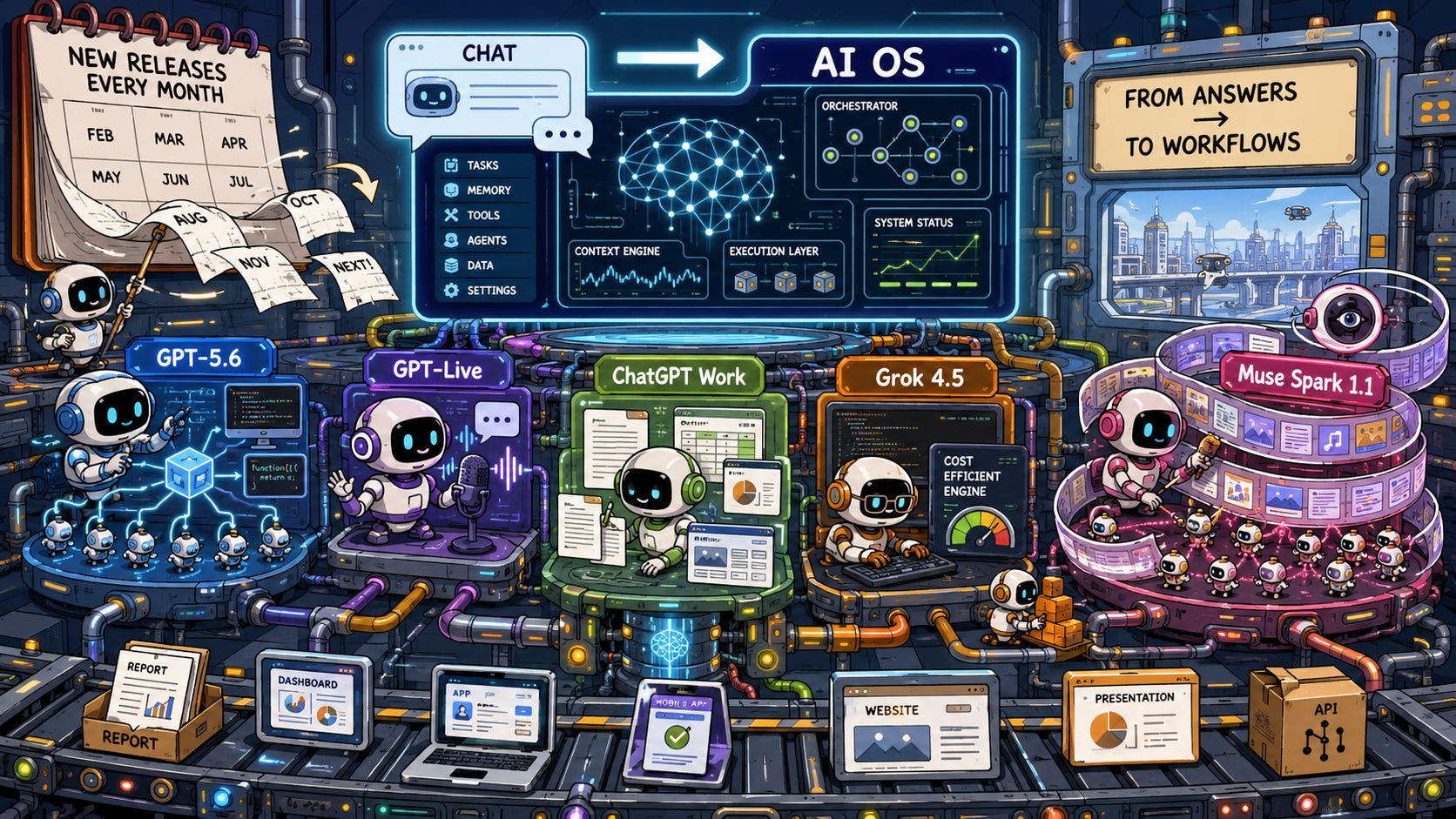
Editorial: GPT-5.6, Grok 4.5, Muse Spark 1.1 and the Post-Chatbot Stack Frontier AI labs have settled into a near-monthly release cadence: a new model, agent, or interface makes last quarter’s frontier feel like legacy infrastructure. This week’s GPT-5.6, GPT-Live, ChatGPT Work, Grok 4.5, and Muse Spark 1.1 reveal a shift. The model is becoming a runtime, the chat window a control plane, and “answering” is giving way to execution.
GPT-5.6 makes that transition explicit. OpenAI split the family into Sol, Terra, and Luna, optimizing for intelligence and performance per dollar. The geekiest feature is programmatic tool calling, which lets the model write programs to coordinate tools and process intermediate results.
Add parallel subagents, and inference starts looking less like autocomplete and more like distributed systems engineering. GPT-Live attacks another bottleneck: the turn-based interface. Its full-duplex architecture can listen and speak simultaneously, decide when to interrupt or remain silent, and delegate deeper reasoning while keeping the conversation alive.
This is not merely better text-to-speech. It is an event loop for human-machine collaboration, replacing “your turn, my turn” with something closer to shared cognitive bandwidth. ChatGPT Work completes the stack.
It can operate across connected apps, websites, and files; stay on a project for hours; and produce editable documents, spreadsheets, presentations, and sites. The product transition is subtle but massive: the unit of value is no longer a response. It is a finished artifact—and, increasingly, an ongoing process.
Meta’s Muse Spark 1.1 makes the race more crowded and cheaper. It combines a million-token context window with multimodal perception, coding, computer use, and multi-agent orchestration. Its most interesting trick may be active context management: compacting extended sessions without losing the state needed later, while choosing between scripting an action and manipulating an interface directly.
The paid Meta Model API also marks a strategic turn. Meta is not just releasing models; it wants to sell metered intelligence. Grok 4.5 arrives at similar coordinates from another direction.
Built for coding, agentic tasks, and knowledge work, it pushes into application generation and complex productivity artifacts. Its aggressive pricing adds pressure to the execution layer. Model competition is becoming a race to deliver the cheapest reliable unit of completed work.
The timing is revealing. Frontier labs are vertically integrating models, voice interfaces, agents, browsers, desktop environments, and artifact layers. They are fighting for ownership of the loop between intent and outcome.
Whoever owns that loop gets the feedback data, developer ecosystem, and switching costs. Of course, the abstraction layer brings new failure modes. Long-running agents need permissions, audit trails, checkpoints, and graceful rollback.
A hallucinated paragraph is annoying; a hallucinated workflow touching your CRM, filesystem, or financial model is an incident. That is why this week matters. The frontier is shifting from raw IQ to systems design: orchestration, latency, token efficiency, computer use, memory, governance, and interface.
The winner may not top every static benchmark. It may be the model that best schedules intelligence across tools, time, and humans. The chatbot era is not ending.
It is being compiled into infrastructure. 🔎 AI Research Separating signal from noise in coding evaluations AI Lab: OpenAI Summary: An audit of the popular SWE-Bench Pro coding benchmark reveals that approximately 30% of its tasks are broken due to issues like overly strict tests, underspecified prompts, and misleading instructions. As these flaws misrepresent true model capabilities, OpenAI retracts its recommendation for the benchmark and emphasizes the need for new, rigorously designed evaluations built by experienced software developers.
An off switch for dual-use knowledge in AI models AI Lab: Anthropic (in collaboration with AE Studio) Summary: This research introduces Gradient-Routed Auxiliary Modules (GRAM), a method that compartmentalizes specific categories of dual-use knowledge—such as virology or cybersecurity—into dedicated, removable neural network modules during training. By using GRAM, developers can effectively toggle dangerous capabilities on or off for different deployment environments without having to expensively retrain the entire model or degrade its general performance.
SkillOpt-Lite: Better and Faster Agent Self-evolution via One Line of Vibe AI Lab: LMMS-Lab, NTU MMLab, and Microsoft Summary: This paper introduces SkillOpt-Lite, a minimal viable pipeline for autonomous agent skill optimization that replaces complex algorithmic architectures with a file-system-based trajectory exploration approach. By treating rollout trajectories as independent flat files and using primitive coding agent tools for consensus mining and validation gating, the framework achieves faster convergence and superior performance across multiple benchmarks compared to heavily engineered baselines.
DSpark: Confidence-Scheduled Speculative Decoding with Semi-Autoregressive Generation AI Lab: Peking University and DeepSeek-AI Summary: DSpark is a speculative decoding framework that combines a semi-autoregressive architecture to mitigate acceptance decay with a hardware-aware confidence scheduler to dynamically tailor verification lengths based on system load. When deployed under live user traffic in the DeepSeek-V4 serving system, this approach significantly improves accepted sequence length and accelerates per-user generation speeds without degrading aggregate throughput. Nemotron-Labs-Diffusion: A Tri-Mode Language Model Unifying Autoregressive, Diffusion, and Self-Speculation Decoding AI Lab: NVIDIA, Georgia Tech, HKU, University of Chicago, and MIT Summary: This research presents a tri-mode language model that harmonizes autoregressive and diffusion objectives within a single architecture, allowing dynamic switching between causal, parallel diffusion, and self-speculation decoding modes.
The resulting Nemotron-Labs-Diffusion model family consistently outperforms state-of-the-art open-
Source and reference
source alternatives by maximizing generation throughput and maintaining high accuracy across various deployment constraints and concurrency levels. Urban congestion relief experiments through routing-app interventions AI Lab: Google Research, UC Berkeley, and Stanford GSB Summary: This paper details a large-scale empirical study across 10 major US cities where a small proportion of Google Maps trips were algorithmically rerouted away from highly congested road segments to less congested alternatives. The intervention yielded an average 2% increase in vehicle speeds on targeted segments and improved overall network travel times, demonstrating that marginal routing adjustments can significantly enhance road efficiency and reduce CO2-equivalent emissions. 🤖 AI Tech Releases GPT 5.6 OpenAI unveiled GPT 5.6 which pushes the frontier of AI models. ChatGPT Work OpenAI released ChatGPT Work...
Read original source- Published
- Jul 12, 2026
- Updated
- Jul 12, 2026
- Source
- Thesequence
- Category
- Technology
- Read time
- 7 min
Key facts
Why this matters locally
This technology story matters locally because it may affect readers, businesses, commuters, families, or public services in British Columbia.
Local impact
BC Post links this item to British Columbia coverage so readers can follow related city updates, weather, traffic, events, and category news in one place.
Timeline
Source and credit
BC Post may summarize, organize, and add local context for reader clarity. Original reporting remains with the listed publisher.
Related Articles
View all Technology
Transformer-manufacturing company to shut down its Chilliwack facility
Technology
Transformer-manufacturing company to shut down its Chilliwack facility
 Technology
Apple’s Lawsuit Could Choke OpenAI’s iPhone Rival Before It Even Ships
Technology
Apple’s Lawsuit Could Choke OpenAI’s iPhone Rival Before It Even Ships
 Technology
Spectro Cloud Raises $100 Million Series D to Help Customers Move AI Infrastructure Into Production Across Enterprise, Public Sector, Neocloud and Sovereign Cloud Environments
Technology
Spectro Cloud Raises $100 Million Series D to Help Customers Move AI Infrastructure Into Production Across Enterprise, Public Sector, Neocloud and Sovereign Cloud Environments
 Technology
Quebec announces plan to train more aerospace workers as demand surges
Technology
Quebec announces plan to train more aerospace workers as demand surges
 Technology
ECT Reprograms Adult Neurons into a Youthful State
Technology
ECT Reprograms Adult Neurons into a Youthful State
 Technology
The Canadian Companies Building AI Infrastructure and Why They Matter
Technology
The Canadian Companies Building AI Infrastructure and Why They Matter
More Local Coverage
Latest news Business
AI Market Trends: Q2 2026 Review and Forecast
Business
AI Market Trends: Q2 2026 Review and Forecast
 Politics
Powerful pro-life ad featuring boxing legend to air during final World Cup matches
Politics
Powerful pro-life ad featuring boxing legend to air during final World Cup matches
 Local News
Cowichan sports shorts: rugby, hockey, biking
Local News
Cowichan sports shorts: rugby, hockey, biking