

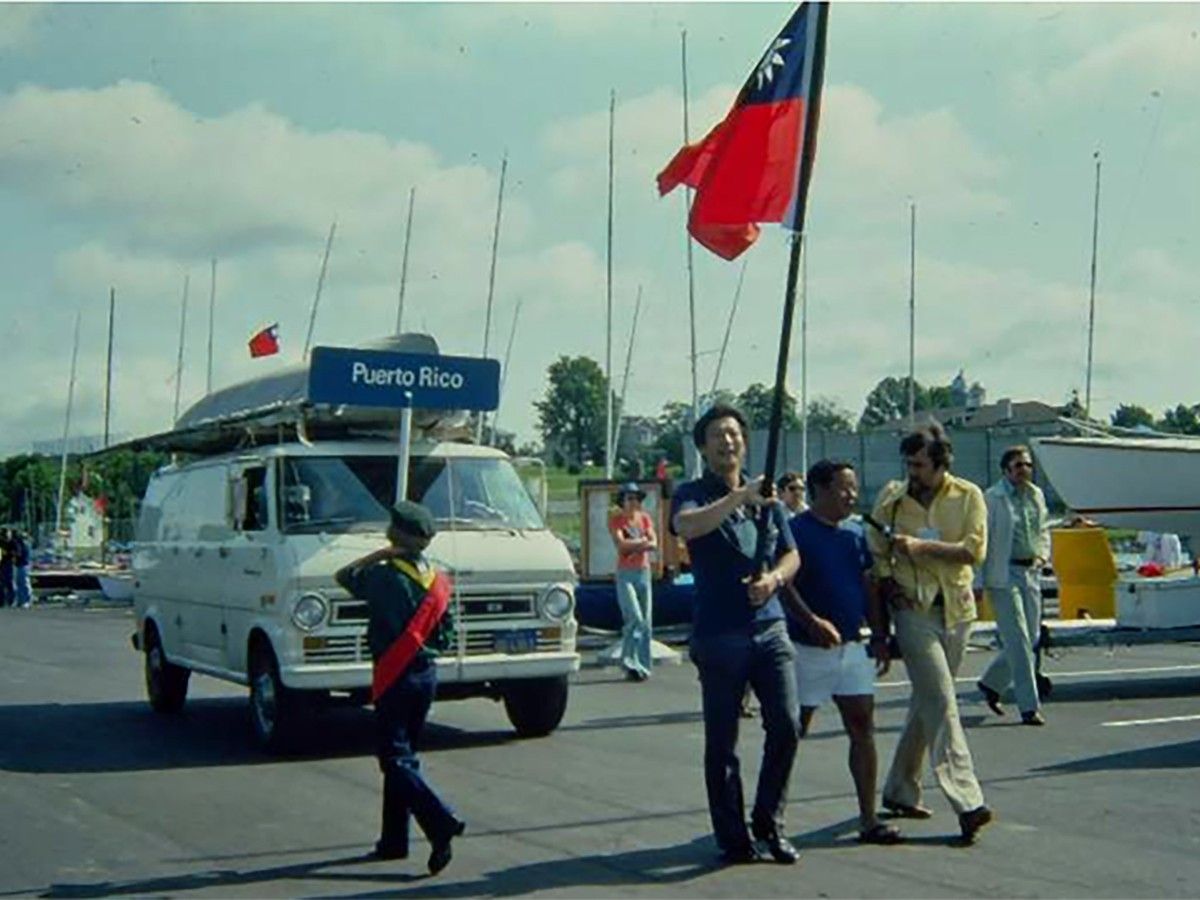
A reporter from the BBC chased down the Lims while the cameras were rolling. “Is this a protest?” he demanded. Foo Lim's reply: “You never fly your flag in protest."
Article content In the dewy quietude of a Kingston dawn in early summer, the brothers piled out of the rust-bucket Ford van they had parked for the night alongside of the cricket pitch. To get out the aches and pains from crashing on air mattresses, they threw around a Frisbee. Nobody would have made them for athletes — they were bespectacled, bookish-looking, hardly rambunctious, a little shaggy maybe, but then again living out of a van for weeks will do that.
They’d have passed for Queen’s students on a tight budget, hanging out until the library opened on its summer hours, unless you spotted the California plates on their rolling dormitory. Recommended Videos You’d have to be of a certain age to appreciate that back in 1976, they’d have been presumed to be in the ranks of a legion: young people striking out across the land, unencumbered by compasses and maps, some on quests of self-discovery, others simply adrift. The see-the-country spirit had been captured as scripture in the pages of On the Road and reached a mass audience on the screen in Easy Rider back in ’69.
By the ’70s, Jack Kerouac’s hitcher’s thumb and Peter Fonda’s chopped Harley were supplanted as the preferred mode of transportation by the utilitarian Econoline. These two by the park had been on the road since February and logged thousands of miles when they set out from Los Angeles. They had taken the farthest thing from a straight line to Kingston, with stops in Florida, Illinois, and Rhode Island, before landing in New York state and rolling up Interstate 81 through Watertown to cross the Thousand Islands Bridge, their 15-foot dinghy on the roof racks.
Yet these two, brothers Yal Lim, 21, and Kui, not quite 20, would soon be thrust into international intrigue playing out on the front pages of newspapers around the world and the lead item on the six o’clock news. All of it would catch them utterly unaware. Olympic movement faced crises The International Olympic Committee voted to award the 1976 Summer Games to Montreal in May 1970, the then-largest city in Canada, beating out Moscow.
Those behind the successful bid had to sign on the committee’s host city contract, a standard document guaranteeing safe entry of athletes and officials representing IOC-recognized nations. The point seemed baked in the cake given Canada’s standing in the international community, its reputation as a benign, fair actor. The Olympic movement had faced a crisis in 1972, when Palestinian terrorists killed 13 members of the Israeli team in Munich, Germany.
When IOC president Avery Brundage resigned two years later, he offered less than heartfelt congratulations to his successor, Lord Killanin of Ireland. “Goodbye, Michael, good luck, there won’t be any games in Montreal.” Brundage’s farewell evoked the Irish curse, Droch chrich ort (“A bad ending upon you”), but it seemed Brundage’s prediction might come true on the eve of the Summer Games.
First came the withdrawal of 29 African nations, a protest of New Zealand’s participation after the government backed its national rugby team’s tour of South Africa, then a pariah nation because of its apartheid policies. Then, less than three weeks out from the opening ceremonies, tensions elevated around the team from the island nation of Taiwan. Since its founding after the Chinese civil war in 1949, Taiwanese athletes had competed in Melbourne in 1956 as Formosa-China; and in Rome in 1960 simply as Formosa.
The latter was the occasion of the nation’s most famous Olympic moment: C.K. Yang’s narrow loss to Rafer Johnson of the U.S. in the decathlon. In 1972, the 21 members of the Taiwanese team marched into Munich’s Olympiastadion under the banner of the Republic of China. Chiang Kai-shek, the first president of the ROC, considered the use of the name, flag and anthem at the Olympics as exercises of a moral right, a staking of Taiwan’s claim to legitimacy after the nation was expelled from the United Nations in 1971.
With Chiang’s death in 1975, his successors determined to again identify as the ROC at upcoming Games. Few had foreseen any possible complications in 1976, yet the dynamics were in place for a confrontation. Months after the IOC had awarded the Games to Montreal, Ottawa had restored diplomatic relations with Beijing, setting the stage for the shipment of grain to the People’s Republic of China.
Out of fear of offending Chairman Mao Zedong and killing trade deals, then prime minister Pierre Trudeau waited until the eve of Montreal’s Olympic moment to announce he wouldn’t allow the Taiwanese team into the country if its officials went ahead with plans to identify as the Republic of China. The dispute escalated. A hue and cry went up.
Sympathetic to Taipei, the U.S. Olympic Committee threatened to pull its team of 396 athletes, the largest in Montreal. As trademark holders, the IOC threatened to block all Olympic branding from the Games — no use of the “O-word,” no five-ring symbol, no torch, and no flame. The hosts faced the prospect of staging “the Montreal Games,” having to refund the tens of millions in broadcast rights, and dealing with outraged taxpayers saddled with the $1.5-billion construction bill.
According to polls taken, Trudeau’s stand on the Taiwan team was the single most unpopular measure of his career. Those travelling from Taiwan understood the historical symbolism and political stakes. Still, they couldn’t have guessed that they’d be denied entry to Canada, caught up in this realpolitik showdown.
What nobody seemed to know at the time was two members of the team had been parked in the van by the cricket pitch on Court Street in Kingston. A classic immigrant story After graduating high school in Honolulu, the Lim brothers landed sailing scholarships to the University of Hawaii. Though not governed by the NCAA, U.S. collegiate sailing dates back to the 19th century in the Ivy League and by the ’40s and ’50s had developed into a bicoastal competition.
The Lims had successes racing Lasers on the college circuit, but they had no illusions about their status in the sport. “We were weekend racers, club racers,” Kui Lim says. In February 1976, a Chinese American named Thomas Hsueh reached to the Hawaii Yacht Club, looking for accomplished sailors who could compete for Taiwan at the Summer Games — that is, those who were either born in China or had at least one parent born in China.
The Lims wired Hsueh to express their eagerness to sign up. The Lims’ family history was a classic immigrant story. Their father, Foo Wey Lim, had left China at age nine with his older brother Keong in 1939, landing in Vancouver not knowing a word of English, riding a train across the continent, then boarding a ship on the East Coast to Ellis Island.
Once Foo and Keong were processed, they rejoined their father who had already made it to the U.S. Foo would graduate from Michigan State, where he met his Hawaiian-born wife Evy. The Lims eventually settled in Rochester, N.Y., where Foo worked in pharmaceutical research and started up several small businesses, while Evy taught grade school. The family started sailing when the boys were in grade school and, when they were teens, Foo and Evy decided to move to Hawaii.
The Taiwanese Olympic organizers approved the Lims, who were almost in disbelief. “Just think of it, competing in the Olympic finals without having to sail in the elimination or the trials,” Kui told a reporter from the Honolulu Star-Bulletin in February 1976. The Lims couldn’t wait for the paperwork to be finalized to begin intensive training for the sailing competition, which for the 1976 Games would be staged in Kingston.
University of Hawaii administrators allowed them to defer a semester and with the Olympic races only five months away, the brothers packed off for the mainland. “The nearest Olympic class to the boats we sailed was the 470s,” Yal Lim says. “We had never raced them, so we reached out to Dave Ullman in Long Beach, the best 470 sailor in the U.S.
Dave had a real community spirit — anyone could train with him. The New Zealanders, Mark Paterson and Brett Bennett, were with him there, so we became training partners.” Training with Ullman and the Kiwis provided the Lims a base, but they understood they needed race experience.
“In Hawaii, we didn’t have much competition,” Kui Lim says. The brothers bought an Econoline and they criss-crossed the U.S. in search of regattas, putting 30,000 miles on the van. The Taiwanese Olympic officials bought them a 470 and they christened the 15-foot dinghy Fire Drill, ruefully evoking an archaic euphemism for a chaotic situation associated with the Chinese.
The Lims were going to name the boat The Spirit of a Free China, but Taiwanese officials judged it to be too dogmatic, so they opted for a touch of self-deprecating humour. The Lims weren’t the only international 470 racers landing in regattas across the U.S. in preparation for Kingston, just the most unlikely other than the team from the Cayman Islands. While it was humbling to crash in the van at campgrounds and grab a motel every third night for a shower and decent sleep, the Lims weren’t the only hardscrabble cases on a circuit perceived to be elitist.
“A few were well funded, but most were like us,” Yal Lim says. “The Canadians we met were college students. For funding, you were almost entirely on your own.”
In June ’76, four weeks before the Summer Games, the Lims crossed the border — they knew the routine from their time as kids in Rochester, when they’d visit Canada on vacation. “We just brought our driver’s licences,” Kui Lim says. The Lims hadn’t brought the paperwork from Taiwan’s Olympic officials that would allow them to access the athletes’ village in Kingston when it opened in June, thus they were once more crashing in their van.
“We bummed around town, maybe more than other Olympic guys,” Yal Lim says. “We went to this hamburger place — Harvey’s — and the manager asked us about our boat, so we told him the story. He gave us coupons for free burgers, so that became the place we kept going to.”
While the Lims embedded in the community, they focused on race preparation — their 470 was docked in the Olympic harbour and they took in the scene in wide-eyed wonderment, fanboys up close to the famous names he knew about from sailing magazines, sailors such as Paul Elvstrom, the Dane who won gold medals in four straight Olympic Games, and Valentin Mankin, twice a gold medallist for the Soviet Union. Yal went slack-jawed when he saw Ingvar Hansson, the 6-foot-7-inch, 240-pound Tempest racer from Sweden. “This guy was a giant,” Yal says.
“We hadn’t seen anything like him at the Kaneohe Yacht Club.” Adds Kui Lim: “Just how good the good guys were was an eyeopener. There wasn’t video or coverage of sailing — you had to see it in person, the speed and intensity.
It just made me respect and love the sport even more.” It dawned on the Lims just how far from home they were, like Dorothy realizing she and Toto weren’t in Kansas anymore. They did reconnect with the New Zealanders and in training sessions were keeping up with the experienced international racers — for their part, the Kiwis seemed caught off guard when their country and national rugby heroes were name-dropped in the African boycott.
The Lims’ confidence in a representative showing in the 470 was growing. “We were as fast, but not as smart as the experienced sailors,” Yal says. “We were still learning.
We didn’t know how we’d do.” Innocents caught in a gathering political monsoon Two weeks out from the opening ceremonies in Montreal, the Lim brothers took a break from training to drive from Kingston to Rochester for a visit a family friend — “our Calabash uncle,” as Yal describes him in Hawaiian slang. They presumed that by the time of their return, their paperwork would be sorted out and they could move directly into the athletes’ residences.
It was at this juncture that Taiwan’s threatened status for the Olympics landed in the headlines. “We were watching TV at our friend’s house, and it was on Walter Cronkite (the CBS Evening News),” Kui says. “We didn’t understand the political stuff — we knew Trudeau had this wheat deal with the communists, but (the People’s Republic of China) wasn’t a member of the Olympic movement, so I couldn’t see why Taiwan’s plans were a problem.”
Former prime minister John Diefenbaker said Trudeau’s decision to block the Taiwan team “was giving Canada a black eye around the world.” Speaking for the Taiwan team, C.K. Yang said: “What if the United States was told it would have to compete under another name? If they didn’t want us here, why did they have to wait until the last minute, after our team had spent months in preparations and had made the long trip across the Pacific?”
The brothers made calls and were reassured when they heard that negotiations were ongoing with support of influential U.S. executives, among them former Olympic sailing gold medallist Julian Roosevelt, a first cousin of former U.S. president Franklin Delano Roosevelt. “We had some big hitters helping us out,” Kui says. “If all else didn’t work out, it looked like we’d be marching with the U.S. team at the opening ceremonies.”
The Lims’ optimism faded when they returned to the border crossing at the Thousand Islands Bridge — customs officers held them for four hours. Just weeks before they had been tourists, but because of global politics they had become persons of interest, intense interest. Others in the Taiwan team had been denied entry to Canada, but they held Taiwanese passports.
The Lims were entering as American citizens — for all the scrambling and phone calls to head office, they couldn’t work up cause to turn them away. When the brothers were allowed through, a security detail was tailing them. An international incident wasn’t avoided, so much as kicked down the 401.
We thought we had a good chance because were on the right side. Yal Lim Foo and Evy Lim were waiting in Kingston, along with their daughter, Wan. Foo was listed as the coach of the Taiwanese sailing entry and Wan as the meteorologist — in other circumstances, the makings of a feel-good story.
In July of 1976, though, they were innocents caught in a gathering political monsoon. The Lim brothers had previously moved around Kingston with a casual freedom, but on their return, they had federal minders and press tailing their every move. For a pair of college kids, it was enough to set the minds spinning.
“Mark Paterson thanked us,” Kui says. “He said Taiwan had taken the Kiwis out of the news.” Taiwan officials tried to get the spotlight off the Lims.
Thomas Hsueh, the ostensible head of the Taiwan sailing program, took the lead role dealing with the media and did his best to shelter the brothers from being drawn into controversy. “We had no time to assess the political impact, so we kept quiet,” Yal says. “I’m sure (the reporters) were frustrated.”
Foo Lim did speak up. “I don’t believe Canada has ever had a black mark on her international history,” he told the Whig-Standard. “It’s hard to believe that what is happening is happening in this country.”
The Lims drove up to Montreal the day before the opening ceremonies and went to bed that night in the Olympic Village, expecting to march the next day in the stadium, at the very least with the U.S team. They still held out hope for last-minute settlement to use a Republic of China banner. “We thought we had a good chance because were on the right side,” Yal says.
To that point in ’76, they had been on a fortuitous run, but the charm had run out: There’d be no resolution. The IOC held out a compromise — proposing that the Taiwan team could march in under its own flag and its anthem, but without any
Source and reference
reference to China on its banner. The United States Olympic Committee deemed this a reasonable middle ground and dropped its threatened withdrawal. Taiwan flatly declined. Taiwanese officials raised their flag in Olympic Village, a symbolic exercise of a right guaranteed them in the Olympic charter, and then packed up. While the contingents from 92 nations marched in Olympic Stadium, 40 Taiwanese athletes waited at the airport for their flight to Chicago, where’d make a connection to Los Angeles ahead of a team charter across the Pacific. Only two team members stayed behind: the Lims, who drove back with their parents and sister to Kingston to collect Fire Drill and their belongings. The Lims were looking to make a discreet exit, but again, good intentions and best-laid plans went awry. At the very moment the brothers pulled up in their van, the officials were staging a final...
Read original source- Published
- Jul 17, 2026
- Updated
- Jul 17, 2026
- Source
- The Kingston Whig Standard
- Category
- Canada
- Read time
- 18 min
Key facts
Why this matters locally
This canada story matters locally because it may affect readers, businesses, commuters, families, or public services in British Columbia.
Local impact
BC Post links this item to British Columbia coverage so readers can follow related city updates, weather, traffic, events, and category news in one place.
Timeline
Source and credit
BC Post may summarize, organize, and add local context for reader clarity. Original reporting remains with the listed publisher.
Related Articles
View all Canada
Vaughn Palmer: NDP was asked four years ago to rescue B.C.'s pulp mills. It didn't
Canada
Vaughn Palmer: NDP was asked four years ago to rescue B.C.'s pulp mills. It didn't
 Canada
Port of Vancouver expansion project referred to Canada’s Major Projects Office
Canada
Port of Vancouver expansion project referred to Canada’s Major Projects Office
 Canada
Vancouver working to avoid ‘the great sigh’ following FIFA World Cup excitement
Canada
Vancouver working to avoid ‘the great sigh’ following FIFA World Cup excitement
 Canada
‘Weather whiplash’ leaves Winnipeg businesses sore
Canada
‘Weather whiplash’ leaves Winnipeg businesses sore


