

Russian gasoline and diesel prices surged further, as continued Ukrainian drone attacks forced the country’s oil refineries to reduce or halt production, deepening a domestic supply crunch.
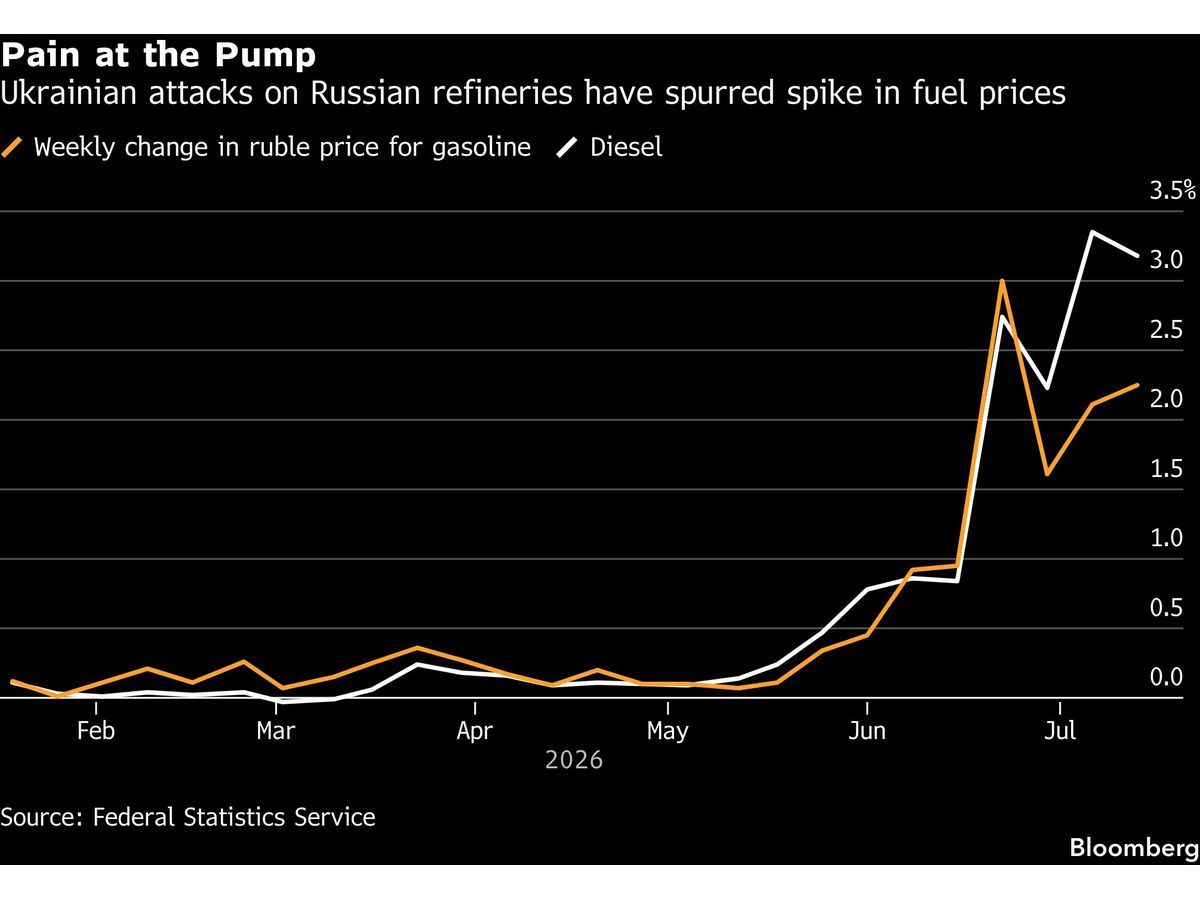
(Bloomberg) — Russian gasoline and diesel prices surged further, as continued Ukrainian drone attacks forced the country’s oil refineries to reduce or halt production, deepening a domestic supply crunch. Average retail prices for gasoline increased 2.3% week-on-week to 75.84 rubles ($0.98) a liter in the July 7-13 period, according to data published by Russia’s Federal Statistics Service late Wednesday. The cost of diesel at the pump advanced 3.2% to 91.21 rubles a liter, the data show.
Russia has seen an unprecedented drop in crude-processing rates to the lowest in more than 21 years due to near-daily Ukrainian strikes on fuel-producing plants. Combined with high seasonal demand for refined products, that has prompted the government to ban almost all exports of diesel, gasoline and jet fuel. Regional authorities across the country have also introduced fuel rationing to address panic buying.
Pressure is mounting for the Kremlin, which is preparing for parliamentary elections in September, as well as for the central bank, which earlier flagged an increase in inflation risks from lower fuel production and warned of a possible pause in its easing cycle. The Bank of Russia will meet to decide on the key rate next week. So far this year, retail gasoline and diesel prices have risen 16.4% and 18% respectively, compared with a 4.64% gain in inflation, according to Federal Statistics Service data.
Average gasoline prices in Russia’s capital reached 72.84 rubles per liter, and 70.75 rubles per liter in President Vladimir Putin’s home city of St. Petersburg, the data show. Rising fuel prices also have “a significant impact” on the prices of other goods and services, the central bank said in its monthly report on economic trends late Wednesday. The extent of possible secondary effects largely depends on how long the supply shock on the fuel market lasts, it added.
“A blistering wave of Ukrainian attacks” has affected more than half of Russia’s refining capacity since the start of May, according to the International Energy Agency, which estimates Russian plants processed 3.8 million barrels a day in June, or almost a third less than a year earlier. Since May, Ukrainian forces have carried out more than 40 attacks on Russia’s fuel-producing facilities, hitting at least 23 out of 34 large refineries, mostly linked to the nation’s major oil producers, according to a Bloomberg tally of public statements from both countries.
- Published
- Jul 15, 2026
- Updated
- Jul 15, 2026
- Source
- Financial Post
- Category
- Crime
- Read time
- 2 min
Key facts
Why this matters locally
This crime story matters locally because it may affect readers, businesses, commuters, families, or public services in British Columbia.
Local impact
BC Post links this item to British Columbia coverage so readers can follow related city updates, weather, traffic, events, and category news in one place.
Timeline
Source and credit
BC Post may summarize, organize, and add local context for reader clarity. Original reporting remains with the listed publisher.
Related Articles
View all Crime
Video shows rescue of lone survivor from deadly B.C. helicopter crash
Crime
Video shows rescue of lone survivor from deadly B.C. helicopter crash
 Crime
Family launches fundraiser for woman struck by truck in Mission
Crime
Family launches fundraiser for woman struck by truck in Mission
 Crime
A dozen cats are missing after New Westminster apartment fire that displaced roughly 100 residents
Crime
A dozen cats are missing after New Westminster apartment fire that displaced roughly 100 residents
 Crime
New Langley Township fire hall opens with ‘push in’ ceremony
Crime
New Langley Township fire hall opens with ‘push in’ ceremony
 Crime
‘N’ driver involved in Abbotsford rollover crash, police say
Crime
‘N’ driver involved in Abbotsford rollover crash, police say
 Crime
Langley woman pleads for break on $49K fines after felling 11 trees
Crime
Langley woman pleads for break on $49K fines after felling 11 trees
More Local Coverage
Latest news Business
AI Market Trends: Q2 2026 Review and Forecast
Business
AI Market Trends: Q2 2026 Review and Forecast
 Politics
Powerful pro-life ad featuring boxing legend to air during final World Cup matches
Politics
Powerful pro-life ad featuring boxing legend to air during final World Cup matches
 Politics
Traditional Catholic response to Cupich’s suicide distortion
Politics
Traditional Catholic response to Cupich’s suicide distortion