

As American anniversary events and the World Cup have demonstrated, bigger, louder and longer does not mean more uplifting
Canadians could well have told our American friends that their semiquincentennial would be underwhelming, if not a flop. At our sesquicentennial back in 2017, we discovered our lost sense of celebratory spectacle. With the political left trumpeting the entire Canadian project to be a criminal enterprise, if not genocidal, and the political right promoting the idea that the left had irreparably broken the country, the fonts of patriotic fervour were running dry.
Canada 150 came and went with rather less than the occasion deserved, especially compared to the centennial in 1967, when Expo ’67 in Montreal marked a months-long festival of Canadian achievement and confidence in the future. It was a long way down over 50 years. The Americans did something similar at their Centennial Exposition, a world’s fair in Philadelphia in 1876.
It showcased American technological progress, including the typewriter, sewing machine, a 1,400-horsepower steam engine and the telephone of Scots-Canadian-American Alexander Graham Bell. The French caught the same spirit for the centennial of the French Revolution in 1889, constructing the Eiffel Tower. Three years earlier they had sent the Statue of Liberty to New York, a gift for the 1876 centennial, though installed in 1886.
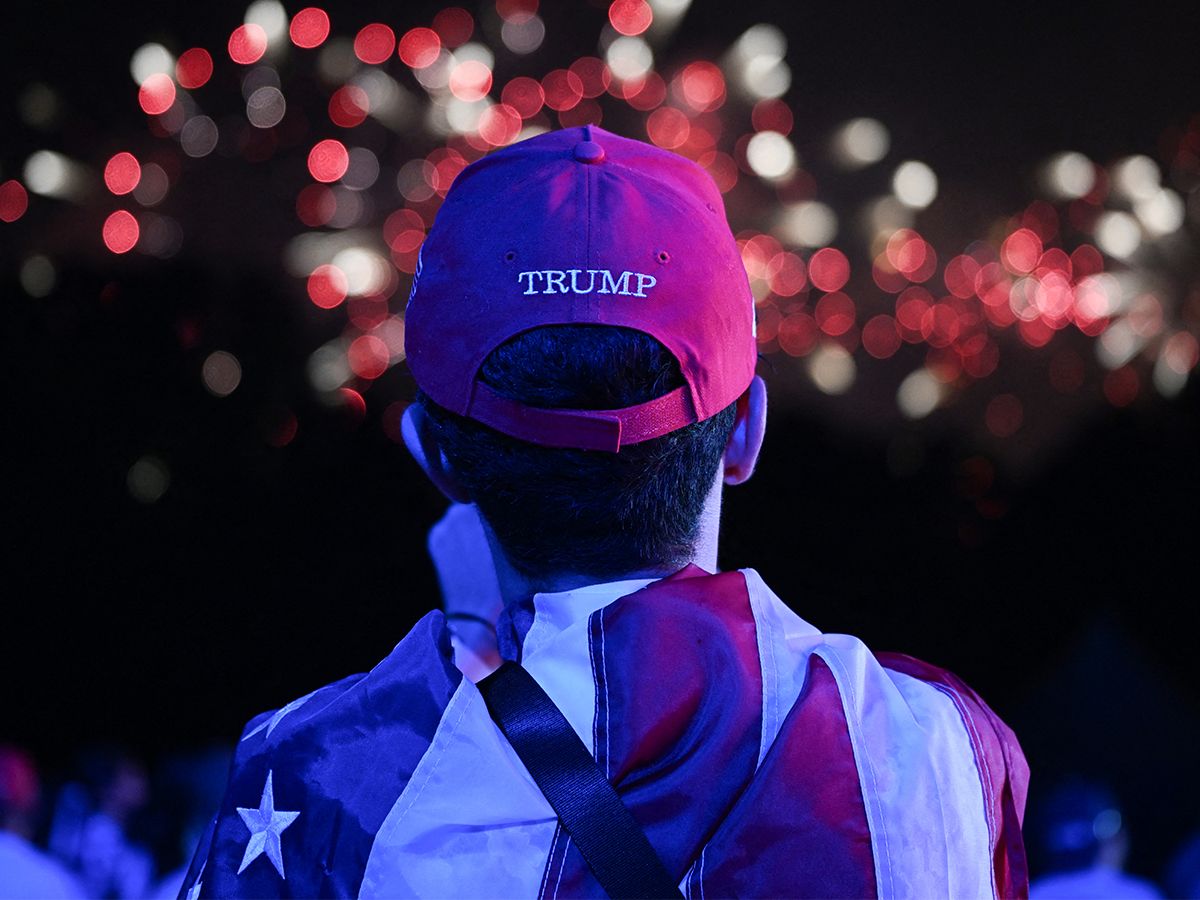
The American bicentennial in 1976 — at a time of economic crisis, political disgrace and the dishonour of Vietnam — was a rousing commemoration with tall ships in New York harbour, Queen Elizabeth II bringing a new bell to Philadelphia, and Rocky Balboa going the distance against Apollo Creed on the big screen. The “bicentennial minutes” on CBS knitted together towns and cities across the land, all of which had their own local festivals. America 250 instead featured the president imagining himself on Mount Rushmore, and a third-rate state fair on the Washington Mall featuring fourth-rate singers, adjacent to an algae-blooming, paint-peeling, dodgy-contracting pool that does reflect something of America’s moment.
It is a long way down over 50 years. At the bicentennial of the French Revolution in 1989, a grand concert at the Place de la Concorde concluded with the incomparable soprano Jessye Norman singing La Marseillaise in an immense tricolore gown that seemed to billow out over the broad avenues of Paris. That was a spectacle.
A year later at the World Cup in Italy, there was the inspired decision to use Puccini’s Nessun Dorma — no one sleeps! — as the BBC title sequence for its coverage. Operatic tenors for football?
It was pure cultural genius, as the closing verses, sung by Luciano Pavarotti, soared: all’alba vincerò! At dawn, I shall win! Plácido
Domingo and José Carreras joined Pavarotti at the ancient ruins of the Baths of Caracalla, on the eve of the World Cup final, for the first “Three Tenors” concert, a performance that had greater impact than the World Cup itself. It was a spectacle in the Eternal City, where public spectacles have been offered for millennia, for good and ill. Pavarotti would sing publicly for the last time to conclude the opening ceremonies of the Turin Olympics in 2006, marrying opera and sport again.
He would die the following year, his final Nessun Dorma closing with the world’s largest curtain drawing down upon him, fireworks to follow. Nessun Dorma made a return at American 250. Sung by “the presidential tenor,” Christopher Macchio, who does not play La Scala, but does gigs at Mar-a-Lago.
“No one sleeps until we hear our president!” exhorted Macchio to the waning crowd, worn out by scorching sun, security exigencies and evacuations due to thunderstorms. Puccini wrote, and Pavarotti sang, of love for a princess, of mystery, of pursuit, of persistence, of hope, of triumph at dawn. Macchio on the Mall sang of a president’s pedestrian speech.
It is a long way down. At the World Cup 2026, the play has been exciting, but there has been no effort for a uniting, universal spectacle. The closest thing was planetary schadenfreude when the American team embarrassed itself at the hands of Belgium after the president intruded only to distract and diminish.
Does it matter? The ancient Romans made us suspicious of public spectacle, the resort to bread and circuses when otherwise the common good was suffering. Spectacle can be put to wicked purposes, as totalitarian regimes have learned only too well.
But the abuse ought not prevent proper use. Forty years ago, the centennial of the Statue of Liberty was marked by its restoration, a nighttime speech by the president, and fireworks — the largest to that point in American history — launched from 30 barges in New York harbour. It was celebratory spectacle, as Americans, Canadians, French and Italians knew how to do.
There were 40 times more fireworks at America 250 than back in 1986, but bigger and louder and longer does not mean more uplifting. Losing our capacity for celebratory spectacle runs down our reserves of unity, harmony, common pride and co-operation. Those are not easily restored.
Celebration gives way to anxious worry. A lively expectation of the dawn becomes just a sleepless night. National Post
- Published
- Jul 12, 2026
- Updated
- Jul 12, 2026
- Source
- National Post
- Category
- Lifestyle
- Read time
- 4 min
Key facts
Why this matters locally
This lifestyle story matters locally because it may affect readers, businesses, commuters, families, or public services in British Columbia.
Local impact
BC Post links this item to British Columbia coverage so readers can follow related city updates, weather, traffic, events, and category news in one place.
Timeline
Source and credit
BC Post may summarize, organize, and add local context for reader clarity. Original reporting remains with the listed publisher.
Related Articles
View all Lifestyle
City of Lethbridge formally agrees to contribute funding for future 32-bed recovery facility
Lifestyle
City of Lethbridge formally agrees to contribute funding for future 32-bed recovery facility
 Lifestyle
Teen hit in crosswalk faces long recovery
Lifestyle
Teen hit in crosswalk faces long recovery
 Lifestyle
PHOTOS: Cyclists in Chilliwack ride in rain to raise funds for multiple sclerosis
Lifestyle
PHOTOS: Cyclists in Chilliwack ride in rain to raise funds for multiple sclerosis
 Lifestyle
Canadian lottery winner thrilled by free plays before noticing much bigger prize
Lifestyle
Canadian lottery winner thrilled by free plays before noticing much bigger prize
 Lifestyle
New Gateway Mall owners hope to bring in a Costco
Lifestyle
New Gateway Mall owners hope to bring in a Costco
 Lifestyle
From overlooked recruit to featured player: Yorkville Christian grad David Douglas Jr. comes home to NIU
Lifestyle
From overlooked recruit to featured player: Yorkville Christian grad David Douglas Jr. comes home to NIU
More Local Coverage
Latest news Business
AI Market Trends: Q2 2026 Review and Forecast
Business
AI Market Trends: Q2 2026 Review and Forecast
 Politics
Powerful pro-life ad featuring boxing legend to air during final World Cup matches
Politics
Powerful pro-life ad featuring boxing legend to air during final World Cup matches
 Local News
Cowichan sports shorts: rugby, hockey, biking
Local News
Cowichan sports shorts: rugby, hockey, biking