

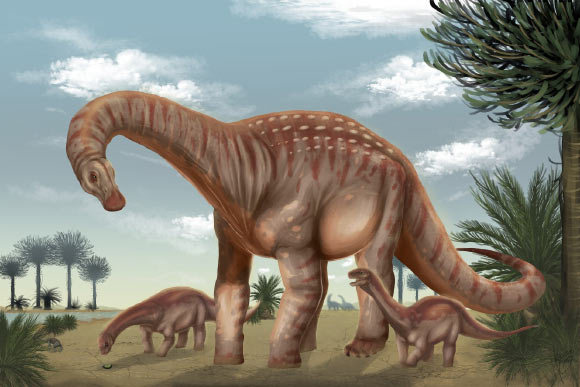
Paleontologists in Uruguay have identified a new species of aeolosaurine titanosaur from a pair of remarkably well-preserved tailbones unearthed in the 1980s near the Uruguay River.
Paleontologists in Uruguay have identified a new species of aeolosaurine titanosaur from a pair of remarkably well-preserved tailbones unearthed in the 1980s near the Uruguay River. Mesetasaurus protector lived in what is now Uruguay between 86 and 72 million years ago (Late Cretaceous epoch). The new species was a member of a group of titanosaurian sauropod dinosaurs known as Aeolosaurini, a lineage that flourished across South America during the final chapters of the Cretaceous.
“Titanosaurians constituted the most abundant and diverse sauropod clade during the Late Cretaceous, with several dozen genera recognized, particularly in South America,” said Dr. Matías Soto Núñez from the Universidad de la República and colleagues. “They were already present by the Valanginian (137 to 132 million years ago), reaching enormous body sizes during the Albian-Cenomanian (113 to 94 million years ago), and were the only sauropods to persist until the end of the Cretaceous (67 million years ago).” “Several lineages thrived in South America, such as Andesauroidea, Diamantinasauria, Saltasauridae, Lognkosauria, and Rinconsauria, including Aeolosaurini.”
“Among them, the latter clade is an endemic component of South American latest Cretaceous faunas.” “The particular morphology of their caudal vertebrae makes them easily recognizable and could lead them to be used as a biostratigraphic proxy.” The two tail vertebrae of Mesetasaurus protector were collected in the 1980s at the site of Meseta de Artigas of the Guichón Formation in northern Uruguay’s Paysandú department.
The specimens were found lying close together in a small exposure of reddish sandstone, suggesting they belonged to a single individual. “Catalogued as FC-DPV 3740A and FC-DPV 3740B, the specimens are among the best-preserved sauropod vertebrae known in Uruguay,” the paleontologists said. To determine where Mesetasaurus protector fit on the dinosaur family tree, they compared it with dozens of other titanosaurs using a large phylogenetic data set.
Their analysis placed the animal deep within Aeolosaurini, alongside its relatives such as Aeolosaurus rionegrinus and Arrudatitan maximus from Argentina and Brazil. The discovery indicates that multiple lineages of giant herbivorous dinosaurs inhabited what is now Uruguay during the Late Cretaceous rather than a single isolated population. “Mesetasaurus protector is the second sauropod species from Uruguay, belonging to a different titanosaur lineage than the saltasauroid Udelartitan celeste,” the researchers said.
“This is the second record of the Aeolosaurini in Uruguay besides a caudal vertebra from the latest Cretaceous Asencio Formation, referred to Aeolosaurus.” A paper describing the discovery of Mesetasaurus protector was published online on July 8, 2026 in the
Source and reference
journal Ameghiniana. _____ Matías Soto Núñez et al. A new Aeolosaurini (Sauropoda, Titanosauria) from the Upper Cretaceous of Uruguay. Ameghiniana, published online July 8, 2026; doi: 10.5710/amgh.19.06.2026.3689
Read original source- Published
- Jul 13, 2026
- Updated
- Jul 13, 2026
- Source
- Sci.news: Breaking Science News
- Category
- Technology
- Read time
- 2 min
Key facts
Why this matters locally
This technology story matters locally because it may affect readers, businesses, commuters, families, or public services in British Columbia.
Local impact
BC Post links this item to British Columbia coverage so readers can follow related city updates, weather, traffic, events, and category news in one place.
Timeline
Source and credit
BC Post may summarize, organize, and add local context for reader clarity. Original reporting remains with the listed publisher.
Related Articles
View all Technology
Transformer-manufacturing company to shut down its Chilliwack facility
Technology
Transformer-manufacturing company to shut down its Chilliwack facility
 Technology
Spectro Cloud Raises $100 Million Series D to Help Customers Move AI Infrastructure Into Production Across Enterprise, Public Sector, Neocloud and Sovereign Cloud Environments
Technology
Spectro Cloud Raises $100 Million Series D to Help Customers Move AI Infrastructure Into Production Across Enterprise, Public Sector, Neocloud and Sovereign Cloud Environments
 Technology
Quebec announces plan to train more aerospace workers as demand surges
Technology
Quebec announces plan to train more aerospace workers as demand surges
 Technology
Apple’s Lawsuit Could Choke OpenAI’s iPhone Rival Before It Even Ships
Technology
Apple’s Lawsuit Could Choke OpenAI’s iPhone Rival Before It Even Ships
 Technology
ECT Reprograms Adult Neurons into a Youthful State
Technology
ECT Reprograms Adult Neurons into a Youthful State
 Technology
GO train users could face delays, cancellations due to ‘crew constraints’: Metrolinx
Technology
GO train users could face delays, cancellations due to ‘crew constraints’: Metrolinx
More Local Coverage
Latest news Business
AI Market Trends: Q2 2026 Review and Forecast
Business
AI Market Trends: Q2 2026 Review and Forecast
 Politics
Powerful pro-life ad featuring boxing legend to air during final World Cup matches
Politics
Powerful pro-life ad featuring boxing legend to air during final World Cup matches