

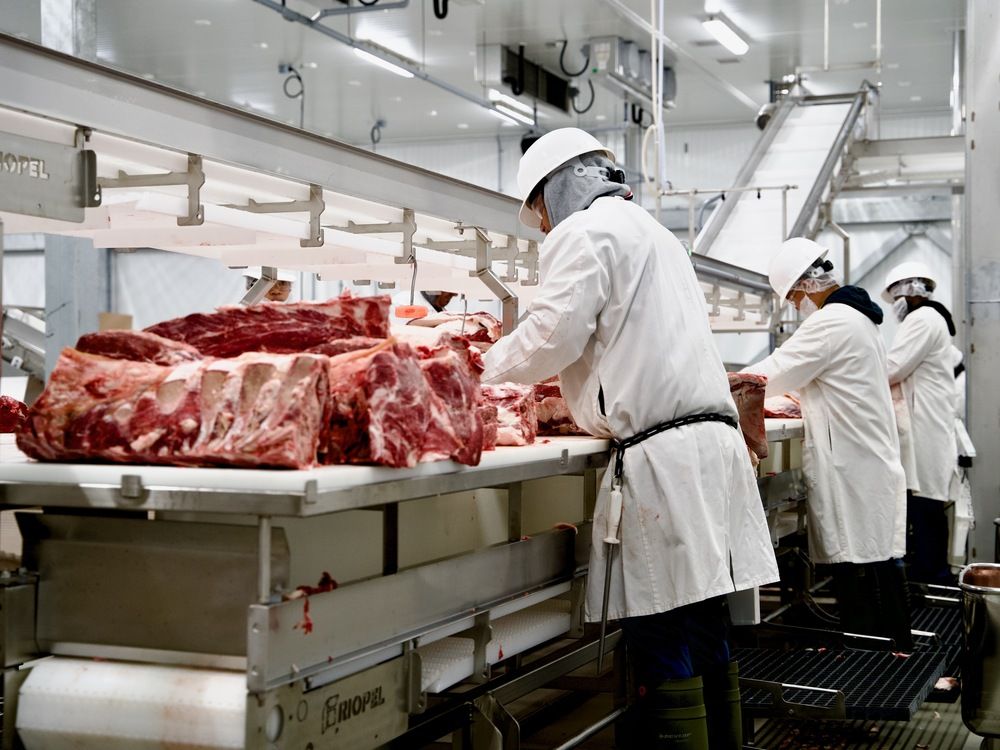
The new facility targets growing demand for halal meat across Canada and international markets.
Yaser Alqayem has been looking to capitalize on what he calls the “significant growth” in demand for halal meat in Canada for the better part of five years. Those plans came to fruition Wednesday as the chief executive of Parkhill-based Blue Lakes Premium Meats said the company became the first federally inspected meat-processing plant to open in Ontario in nearly two decades. The designation allows it to sell meat products to other provinces and international markets.
The $30-million, state-of-the-art facility will be able to process about 350 cattle and 500 lambs a week, helping increase Ontario’s meat-processing capacity. But don’t expect it to bring major relief to meat prices. “Ontario has the most halal customer population, but in other provinces within Canada, there is increasing demand for halal as well,” Alqayem, Blue Lakes’ chief executive and a former IT director at Canada Life Assurance Co., said.
“(The federal licence) opens the door for us to go beyond Ontario and also to other international markets, especially in the Middle East, where they are looking for halal-certified, but also corn-fed beef products, which are recognized internationally as the highest quality.” For consumers, however, increased processing capacity will do little to reduce meat prices in the short term. Prices have risen about 60 per cent over the past five years, said Kevin Grier, a livestock market analyst based in Guelph.
The biggest issue for consumers remains that cattle supply across North America remains “at record lows” at a time when demand for meat products is high, he said. “There’s no more cattle being created because there’s a new plant,” Grier said. Grier said Canadians should expect upward pressure on beef prices to continue into 2028 as farmers try to grow their herds.
The only way to increase cattle supplies is to send fewer cows for processing while herd numbers recover. “The supply is going to get worse before it gets better,” he said. “The only question in terms of declining prices is whether or not demand starts to weaken, and that has shown no signs of weakening in the last few years.
There’s no reason to expect lower beef prices for the foreseeable future.” Nevertheless, trade tensions between Canada and the United States, which decided on July 1 not to renew the Canada-U.S.-Mexico Agreement, have made provinces and the federal government more interested in simplifying rules to allow for more interprovincial trading of products, including meat. Alqayem said Blue Lakes, formerly Parkhill Meats, worked with federal regulators from the planning stages of the new facility to make the process as smooth as possible.
“After COVID-19, with the interruption of the food supply chain, the government recognized the need for maintaining local supply chains in the food sector, especially in the meat industry, so we were also successful in getting a grant that helped us in establishing the new federal plant,” he said. Franco Naccarato, chief executive of Meat and Poultry Ontario, a provincial umbrella group for butchers, meat processors and their suppliers, said businesses in the sector are impacted in two ways. One is meat processing capacity, which is often cited by Ontario cattle, chicken and sheep farmers as one of their biggest barriers to growth, he said.
The other is selling across borders. “It’s quite well known in the sector that we need to ramp up our processing capacity,” he said. “The ability for provincial plants to sell interprovincially is a big item, a big challenge.
It’s being addressed, and we’re trying to see where it could go, but we need more support to help these businesses that have that market potential to grow.” Mike von Massow, a food economist at the University of Guelph in Ontario, said the lack of packing capacity could be constraining growth among farmers and meat packers. “Particularly within Canada and within North America, our beef supply chain is quite resilient,” he said.
“The lack of packing capacity . . . doesn’t necessarily hurt food security or food sovereignty in Canada, but it can hurt economic security because we’re not using our production base for the highest possible value outputs.”
- Published
- Jul 15, 2026
- Updated
- Jul 15, 2026
- Source
- Lfpress
- Category
- Business
- Read time
- 3 min
Key facts
Why this matters locally
This business story matters locally because it may affect readers, businesses, commuters, families, or public services in British Columbia.
Local impact
BC Post links this item to British Columbia coverage so readers can follow related city updates, weather, traffic, events, and category news in one place.
Timeline
Source and credit
BC Post may summarize, organize, and add local context for reader clarity. Original reporting remains with the listed publisher.
Related Articles
View all Business
AI Market Trends: Q2 2026 Review and Forecast
Business
AI Market Trends: Q2 2026 Review and Forecast
 Business
Starchuk seeking judicial review of Surrey arena land-swap
Business
Starchuk seeking judicial review of Surrey arena land-swap
 Business
B.C.'s Massey Tunnel replacement doubles in cost to estimated $8.5 billion
Business
B.C.'s Massey Tunnel replacement doubles in cost to estimated $8.5 billion
 Business
This is the design of Coquitlam's new aquatic and community centre on the Fraser River
Business
This is the design of Coquitlam's new aquatic and community centre on the Fraser River
 Business
Earth Angel Worldwide Expands Its Mission Through Music, Education and Environmental Stewardship
Business
Earth Angel Worldwide Expands Its Mission Through Music, Education and Environmental Stewardship
More Local Coverage
Latest news Politics
Powerful pro-life ad featuring boxing legend to air during final World Cup matches
Politics
Powerful pro-life ad featuring boxing legend to air during final World Cup matches
 Top
‘Entire city’ asked to help search for missing 11-year-old Parker: Calgary police
Top
‘Entire city’ asked to help search for missing 11-year-old Parker: Calgary police
 Politics
Traditional Catholic response to Cupich’s suicide distortion
Politics
Traditional Catholic response to Cupich’s suicide distortion