

Nokian Tyres H1 2026 slides: profit surges on volume, pricing gains
U.S. futures slide with AI worries in focus; Netflix disappoints Introduction & Market Context Nokian Tyres presented its half-year 2026 financial results on July 17, revealing a dramatic profitability turnaround as the Finnish tire manufacturer benefits from higher sales volumes, improved pricing, and lower manufacturing costs. The company’s shares rose 5.43% to $13.60, approaching the 52-week high of $13.85, as investors welcomed the operational improvements following the completion of a major investment phase. The presentation, delivered by President and CEO Paolo Pompei and CFO Timo Koponen, highlighted second-quarter operating profit of €34.8 million—more than double the €14.8 million reported a year earlier.
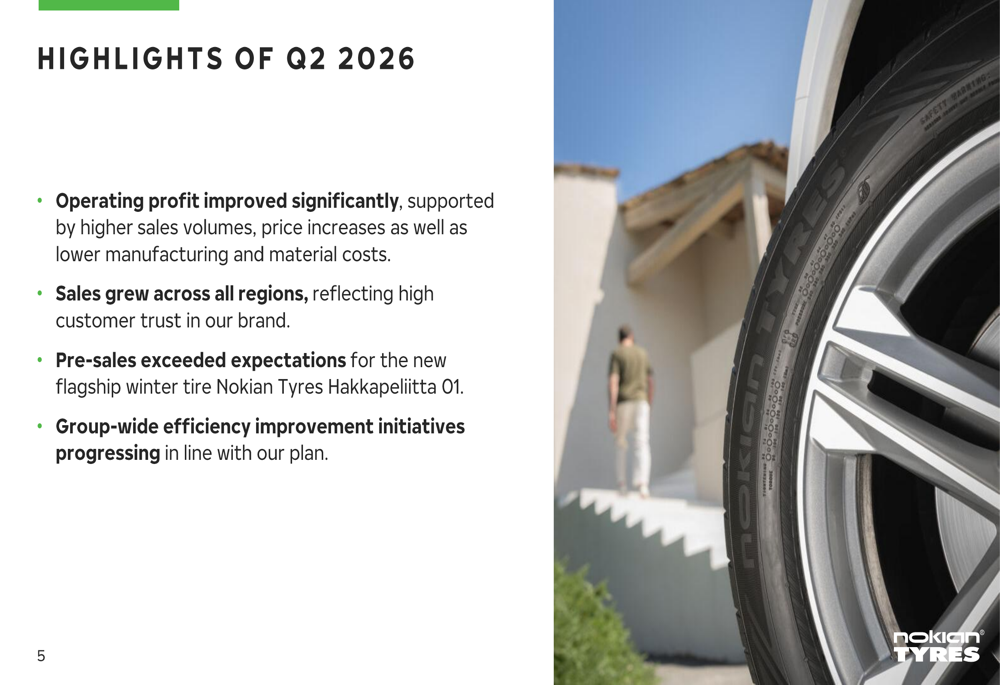
Net sales grew 10.6% to €379.9 million, with growth across all regions despite challenging market conditions, particularly in North America where replacement tire demand fell 5%. Quarterly Performance Highlights As shown in the following overview of second-quarter achievements, Nokian Tyres demonstrated strong execution across multiple dimensions. The company’s Q2 performance reflected broad-based improvements.
Operating profit benefited from higher sales volumes, price increases, and lower manufacturing and material costs. Sales grew across all regions, with management noting "high customer trust in our brand." Pre-sales for the new flagship winter tire, Nokian Tyres Hakkapeliitta 01, exceeded expectations, while group-wide efficiency improvement initiatives progressed according to plan.
The following chart illustrates the substantial year-over-year growth in key financial metrics for the second quarter. Segments EBITDA increased 34% to €76.8 million, representing 20.2% of net sales compared to 16.7% in the prior-year period. Segments operating profit rose 71% to €45.0 million, or 11.8% of net sales, up from 7.7% a year earlier.
These improvements position the company closer to its medium-term profitability targets. Regional and Business Unit Performance The company’s geographic performance showed notable divergence, with Central and Southern Europe leading growth while North America faced market headwinds.
Central and Southern Europe delivered exceptional growth of 31.0% in comparable currencies, with net sales reaching €99.5 million. The Nordics grew 3.4% to €194.8 million, while North America increased 3.7% to €82.7 million despite the 5% market contraction, suggesting market share gains. By business unit, Passenger Car Tyres led the way with 13.7% growth to €235.0 million, supported by improved average selling prices and an increased share of 18-inch and larger tires.
Heavy Tyres returned to growth with a 10.1% increase to €67.1 million, driven by broad-based gains across end-use segments, particularly agricultural tires. Vianor’s retail operations remained essentially flat at €100.7 million. Product Mix and Strategic Positioning
The company’s product mix evolution supports its premium positioning strategy, as illustrated in the following breakdown of tire categories and sizes. All-season and all-weather tires showed the fastest growth trajectory, though winter tires remained the largest segment by sales value at 65% of Q2 sales. Importantly, the share of 18-inch and larger tires increased to 50% from 48% year-over-year, supporting higher average selling prices and improved margins.
This shift toward larger, premium tire sizes aligns with broader industry trends toward larger wheel diameters on new vehicles. Detailed Financial Analysis The comprehensive financial overview demonstrates the magnitude of Nokian Tyres’ profitability recovery over the past year. For the first half of 2026, net sales reached €659.6 million, up 7.6% from €613.2 million in the prior year.
More significantly, operating profit swung to €17.0 million from a loss of €21.1 million, while segments operating profit surged 421.8% to €40.7 million. The segments return on capital employed (ROCE) improved to 6.1% on a rolling 12-month basis from 3.7% a year earlier. Interest-bearing net debt decreased to €815.0 million from €863.9 million year-over-year, reflecting improved cash generation despite working capital investments to support sales growth.
The following waterfall analysis shows how volume, pricing, and cost factors contributed to Passenger Car Tyres’ segment operating profit improvement in Q2. Sales volume contributed €10 million to the profit increase, while price and mix added €6 million. Materials provided a €9 million tailwind, though this benefit is expected to reverse in the second half as raw material costs rise.
Supply chain costs increased €3 million, and selling, general, and administrative expenses rose €2 million with business growth. Market Context and Industry Dynamics Nokian Tyres operates in a mixed market environment, with European and North American conditions diverging significantly. The passenger car and light truck replacement tire market remained soft, particularly in North America with a 5% decline, while Europe held flat.
However, European heavy tire segments showed resilience, with truck tire replacement demand up 10% and agricultural and forestry tires growing 5%. These market dynamics influenced the company’s regional performance, with growth concentrated in Europe while North America faced headwinds. Business Unit Deep Dive The Passenger Car Tyres segment, representing the largest portion of Nokian’s business, demonstrated strong momentum in the quarter.
Net sales increased 13.7% in comparable currencies to €235.0 million, with segment operating profit more than doubling to €35.5 million, representing a 15.1% margin. The improvement was driven by price increases, volume growth, and lower manufacturing and material costs. Positive initial customer response to the new flagship Hakkapeliitta 01 winter tire suggests continued momentum into the crucial fall selling season.
Heavy Tyres returned to growth after several challenging quarters, as shown in the following performance summary. Net sales increased 10.1% in comparable currencies to €67.1 million, with broad-based growth across end-use segments led by agricultural tires. Segment operating profit improved to €10.1 million, or 15.0% of net sales, supported by disciplined pricing and cost management.
This profitability level demonstrates the segment’s potential when market conditions stabilize. Cash Flow and Financial Position The company’s transition from a major investment phase to normalized capital spending is improving cash generation, as illustrated in the following CAPEX trend analysis.
Capital expenditures are normalizing toward depreciation levels over time, with 2026 CAPEX expected at approximately €100 million, down from around €120 million in 2025 (which included €32.6 million in Romanian state aid). This represents a significant decline from the peak of roughly €330 million in 2024 during the Romanian factory construction phase. The following waterfall chart shows how various factors influenced cash flow in the first half of 2026.
While sales growth led to increased working capital requirements, impacting cash flow by €14 million, this was more than offset by improved EBITDA (+€44 million) and significantly lower investments (+€65 million contribution). The "Debts and other" category showed a €109 million outflow, primarily reflecting debt repayments and other financing activities. The company’s debt position and maturity profile remain manageable, as shown in the following breakdown.
Net debt decreased to €815 million from €864 million year-over-year, with available liquidity of €380 million including €88 million in cash and €292 million in committed undrawn credit facilities. The debt maturity profile shows significant maturities in 2028 (50% of total debt) and 2029 (16%), providing near-term refinancing visibility. Sustainability Leadership Nokian Tyres received notable recognition for its environmental performance, reinforcing its premium brand positioning.
The Financial Times ranked Nokian as the #1 tire company and 39th overall among 600 companies on Europe’s Climate Leaders list. TIME magazine recognized the company among the world’s most sustainable companies, ranking 100th among the top 750 globally. These accolades support the company’s premium positioning and appeal to environmentally conscious consumers and fleet operators.
Strategic Outlook and Guidance Management maintained its full-year 2026 guidance despite the strong first-half performance, citing uncertainty in the business environment and expected raw material cost increases in the second half. The company expects net sales to grow compared to 2025, with segments operating profit representing 8-10% of net sales. The strategic execution framework emphasizes four key areas, as outlined in the presentation: premium positioning through brand, products, and pricing; disciplined execution and efficiency improvements; new products driving growth in selected segments including winter, all-season, and agricultural tires; and the completion of the investment phase creating a foundation for stronger cash generation.
The Romanian factory continues to ramp ahead of schedule and is expected to produce more than 2 million tires in 2026, providing capacity for future growth. Management indicated that existing capacity across plants in Romania, Dayton, and Nokia could support revenue of €1.8 billion to €2.0 billion by 2029, suggesting significant runway without major additional capital investments. Looking ahead, the company faces a mixed environment with flat passenger car and light truck replacement tire demand expected (ranging from -2% to +2%), while European truck tire demand should grow 5-10% and agricultural and forestry tire demand is projected to increase 0-5%.
Management acknowledged that raw material costs are likely to rise in the second half, particularly toward the end of Q3 and into Q4, though the company expects to offset these increases through pricing actions over time. The following historical segment operating profit trends illustrate the company’s recovery trajectory. The data shows Nokian Tyres has successfully reversed negative profitability trends from 2022-2023, with Q2 2026 segment operating profit of €45.0 million representing the highest quarterly figure in the period shown.
On a cumulative basis, the first half of 2026 reached €40.7 million in segment operating profit, demonstrating sustained improvement rather than a one-time benefit. The presentation emphasized that strategy execution is underway and delivering results, with premium positioning strengthening, efficiency improvements supporting profitability, new products driving growth, and the investment phase completed. These factors position Nokian Tyres for continued recovery as it leverages new production capacity and an enhanced product portfolio in its core winter, all-season, and specialty tire segments.
Full presentation:
- Published
- Jul 17, 2026
- Updated
- Jul 17, 2026
- Source
- Investing Canada
- Category
- Business
- Read time
- 7 min
Key facts
Why this matters locally
This business story matters locally because it may affect readers, businesses, commuters, families, or public services in British Columbia.
Local impact
BC Post links this item to British Columbia coverage so readers can follow related city updates, weather, traffic, events, and category news in one place.
Timeline
Source and credit
BC Post may summarize, organize, and add local context for reader clarity. Original reporting remains with the listed publisher.
Related Articles
View all Business
AI Market Trends: Q2 2026 Review and Forecast
Business
AI Market Trends: Q2 2026 Review and Forecast
 Business
Starchuk seeking judicial review of Surrey arena land-swap
Business
Starchuk seeking judicial review of Surrey arena land-swap
 Business
B.C.'s Massey Tunnel replacement doubles in cost to estimated $8.5 billion
Business
B.C.'s Massey Tunnel replacement doubles in cost to estimated $8.5 billion
 Business
Earth Angel Worldwide Expands Its Mission Through Music, Education and Environmental Stewardship
Business
Earth Angel Worldwide Expands Its Mission Through Music, Education and Environmental Stewardship
More Local Coverage
Latest news Politics
Powerful pro-life ad featuring boxing legend to air during final World Cup matches
Politics
Powerful pro-life ad featuring boxing legend to air during final World Cup matches
 Local News
Cowichan sports shorts: rugby, hockey, biking
Local News
Cowichan sports shorts: rugby, hockey, biking