

Lifco H1 2026 slides: margins expand as recovery gains momentum
US concludes third round of strikes against Iran after Trump reinstates blockade Introduction & Market Context Lifco AB presented its interim report for the first half of 2026 on July 14, showing a strengthening recovery across most business segments as the Swedish industrial conglomerate emerged from what management described as its most difficult year since going public in 2014. The company reported double-digit sales growth and margin expansion in the second quarter, driven by both organic growth and strategic acquisitions. With shares trading at $30.46, near the upper end of their 52-week range of $14.50 to $35.70, investors appeared to have largely priced in the recovery narrative.
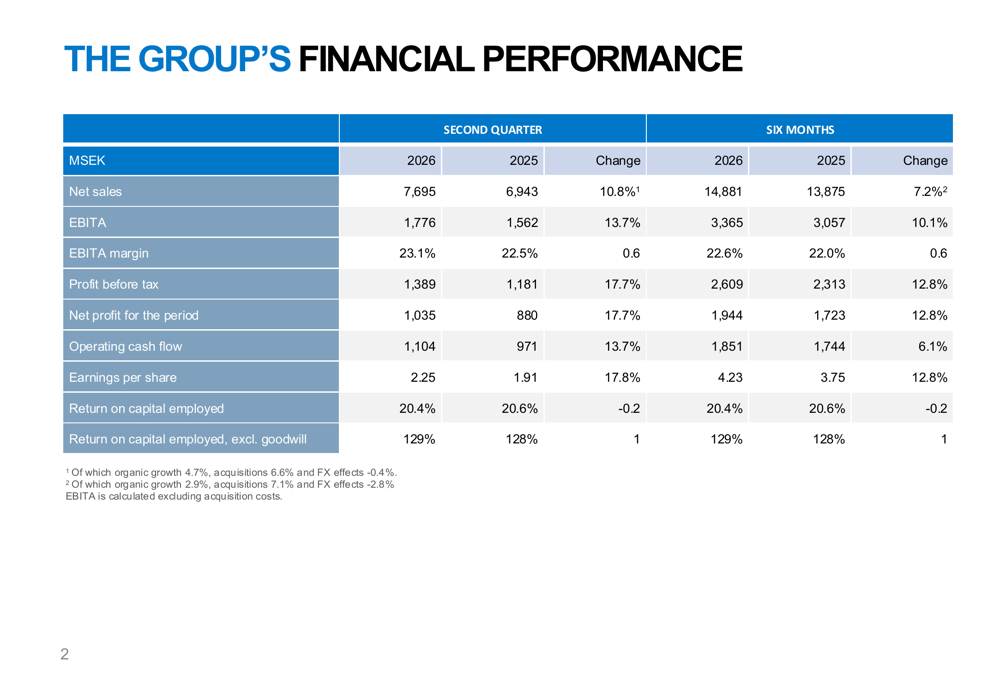
The company’s market capitalization stood at $15.5 billion, with the stock trading at a P/E ratio of 40.85. Quarterly Performance Highlights Lifco delivered solid second-quarter results that demonstrated improving operational leverage across its diversified portfolio. As shown in the following table of key financial metrics, the company achieved growth across all major performance indicators.
Net sales reached 7,695 MSEK in the second quarter, representing a 10.8% increase from 6,943 MSEK in the prior-year period. The growth composition included 4.7% organic expansion, 6.6% from acquisitions, and a modest 0.4% currency headwind. EBITA climbed 13.7% to 1,776 MSEK, while the EBITA margin expanded 60 basis points to 23.1% from 22.5% a year earlier.
Net profit increased 17.7% to 1,035 MSEK, translating to earnings per share of 2.25, up from 1.91 in Q2 2025. Operating cash flow grew 13.7% to 1,104 MSEK, underscoring the company’s strong cash generation capabilities. For the six-month period, net sales rose 7.2% to 14,881 MSEK, with EBITA advancing 10.1% to 3,365 MSEK.
The EBITA margin improved to 22.6% from 22.0%, while net profit gained 12.8% to 1,944 MSEK. Earnings per share reached 4.23, compared to 3.75 in the first half of 2025. Business Segment Performance
The company’s five business areas showed varying performance trajectories during the quarter, with Transportation Products and Environmental Technology leading the recovery. The following breakdown illustrates each segment’s contribution to overall growth. Transportation Products emerged as the strongest performer, with second-quarter sales surging 22.0% to 1,100 MSEK and EBITA jumping 26.2% to 253 MSEK.
The segment’s EBITA margin expanded to 23.0% from 22.2%, reflecting strong operating leverage as the business rebounded from a weak 2025 base. Environmental Technology also posted impressive results, with sales increasing 10.3% to 886 MSEK and EBITA rising 16.6% to 238 MSEK. The segment’s EBITA margin improved 150 basis points to 26.9%, the highest among all business areas.
Management attributed the strength to organic growth and robust aftermarket demand, particularly in marine-related businesses. Systems Solutions delivered sales growth of 19.4% to 2,225 MSEK, with EBITA advancing 22.5% to 502 MSEK. The segment benefited from stabilization in contract manufacturing and continued strength across its diversified portfolio of infrastructure and special products.
The Dental segment, which management considers essentially non-cyclical, achieved sales growth of 4.9% to 1,678 MSEK. EBITA increased 10.4% to 380 MSEK, with the margin expanding 120 basis points to 22.7%. The company continued its strategic shift toward higher-margin proprietary products in this segment.
Demolition & Tools remained the weakest performer, with sales edging up just 1.8% to 1,806 MSEK and EBITA rising 2.7% to 457 MSEK. The segment’s EBITA margin improved only slightly to 25.3% from 25.1%. For the six-month period, sales actually declined 0.8% while EBITA fell 6.2%, with the margin contracting 130 basis points to 23.9%.
Management indicated this segment remains far below 2023 levels with no clear recovery timing in sight. Long-Term Value Creation Track Record Lifco’s presentation emphasized its consistent track record of compounding growth since its 2014 IPO. The company’s free cash flow per share has grown at a 20.3% compound annual rate from 2014 through the last twelve months ending June 2026, as illustrated in the following chart.
Free cash flow per share after capital expenditures and before dividends and acquisitions reached 10.1 in the last twelve months, up from 9.8 in 2025 and 8.6 in 2024. This metric has increased more than ninefold since 2014, when it stood at just 1.1, demonstrating the company’s ability to convert earnings into cash while funding growth. The company’s disciplined approach to capital allocation has supported this performance.
As shown in the following analysis of net debt development and balance sheet position, Lifco has maintained financial flexibility while pursuing acquisitions. Net debt stood at 13,348 MSEK as of June 30, 2026, with a net debt-to-EBITDA ratio of 1.8 times, down from 1.9 times a year earlier and within the company’s target range of 2-3 times. Interest-bearing net debt to EBITDA was even lower at 1.2 times, compared to 1.3 times in the prior year.
Total assets increased to 43,673 MSEK from 40,039 MSEK a year earlier, while shareholders’ equity rose to 20,477 MSEK from 18,053 MSEK. Growth Strategy and Capital Efficiency Lifco’s growth model combines organic development with selective acquisitions, as demonstrated by the company’s historical EBITA growth composition. The following table breaks down the sources of EBITA expansion over the past decade.
From 2015 through 2025, acquisitions contributed an average of 12% to annual EBITA growth, while organic growth added 6% and foreign exchange effects contributed 1%, resulting in total average EBITA growth of 19% per year. In 2025, acquisitions delivered 10% EBITA growth, though organic growth was flat and currency effects were negative 3%, yielding total EBITA growth of 7%. The company’s capital efficiency metrics remain exceptional.
Return on capital employed excluding goodwill and other intangible assets stood at 129% for the last twelve months, compared to 132% for full-year 2025 and 128% a year earlier. This metric significantly exceeds the company’s target of 50%, as shown in the following comparison. Even when including goodwill and intangible assets, Lifco’s return on capital employed reached 20.4% for the last twelve months, just below the 20.5% achieved in 2025 but well above the company’s 12.5% target.
These metrics underscore management’s focus on maintaining high returns while deploying capital for growth. The company has demonstrated consistent profit growth over nearly two decades, as illustrated in the following chart tracking EBITA development from 2006 through the last twelve months. Sales grew at a 12.8% compound annual rate from 2006 through the last twelve months ending June 2026, while EBITA expanded at a 17.1% CAGR over the same period.
The EBITA margin has improved steadily from 14.2% in 2014 to 22.6% in the last twelve months, reflecting both operational improvements and a shift toward higher-margin businesses. Business Portfolio and Geographic Presence Lifco operates through five business areas serving niche B2B markets globally. The company’s diversified portfolio provides exposure to both cyclical and non-cyclical end markets, with the following breakdown showing each segment’s contribution to total sales and EBITA for the last twelve months.
Systems Solutions represented the largest segment at 28% of sales and 26% of EBITA, encompassing contract manufacturing, infrastructure products, and special products. Demolition & Tools accounted for 23% of sales and 24% of EBITA, supplying demolition robots, crane attachments, and tools for excavators globally. The Dental segment contributed 22% of sales and 21% of EBITA, serving European and U.S. markets with consumables, equipment, and services.
Transportation Products generated 15% of both sales and EBITA, providing niche products for transportation vehicles, aerospace, and industrial applications. Environmental Technology, the smallest segment at 12% of sales, delivered 14% of EBITA, reflecting its higher margin profile from solutions that improve work environments and support recycling. Geographically, Lifco maintains a strong European presence with diversified exposure across markets.
The company’s 2025 sales split showed the Rest of Europe accounting for 23%, Germany 15%, the UK 13%, and the Nordic countries combining for 34% (Sweden 9%, Finland 9%, Norway 7%). North America represented 9% of sales, while Asia and Australia contributed 8%. Cash Flow Generation and Capital Allocation
The company’s business model emphasizes asset-light operations and tight working capital management, resulting in strong cash conversion. The following chart illustrates Lifco’s operating cash flow development alongside its capital expenditure and acquisition spending. Operating cash flow after tax and before investments reached 5,124 MSEK in 2025, representing a cash flow conversion rate of approximately 81% of EBITA.
The company maintained low maintenance capital expenditure requirements, with capex as a percentage of sales consistently running between 1.0% and 1.4% over the past decade. This capital efficiency stems from Lifco’s strategy of outsourcing a large share of basic manufacturing, allowing subsidiaries with their own production to minimize required investments. The approach has enabled the company to generate substantial free cash flow while funding both organic growth and acquisitions.
In 2025, Lifco spent 3,360 MSEK on acquisitions, down from the 3,718 MSEK deployed in 2023 but maintaining the company’s active acquisition pace. The enterprise value of acquired entities during 2025 totaled 3,913 MSEK, with estimated full-year EBITA of 598 MSEK, implying an average acquisition multiple of approximately 6.5 times EBITA. Strategic Acquisitions and Integration Lifco completed five acquisitions in the first half of 2026 with combined annual sales of approximately 624 MSEK.
These transactions included Ethoss Regeneration in the Dental segment, Metalltech and Glass Umbrella in Systems Solutions, Salifert in Environmental Technology, and Boscaro in Demolition & Tools. The company has completed 161 acquisitions from 2006 through mid-2026, with the pace accelerating in recent years. From 2017 through 2026, Lifco averaged approximately 15 acquisitions per year, compared to roughly 6 per year from 2006 through 2016.
By segment, Dental has been the most active acquisition area with 61 transactions over the period, followed by Systems Solutions with 47, Demolition & Tools with 25, Environmental Technology with 15, and Transportation Products with 13. Geographically, Germany and Sweden have each accounted for 30% of total acquisitions, with the UK contributing 25% and Italy 21%. Management emphasized during the earnings call that the acquisition pipeline remains "extremely high," with numerous discussions underway.
However, the company maintains strict discipline on valuations and deal quality, willing to walk away from transactions that don’t meet its standards. CEO Per Waldemarson reiterated the company’s philosophy: "When we buy a company, we’re going to keep it forever." Business Philosophy and Sustainability Lifco’s "safe haven" approach to business ownership emphasizes long-term value creation through decentralized management and operational continuity.
The company essentially never sells acquired businesses, makes all decisions at the local management level, and has never relocated a business after acquisition. This philosophy supports employee retention and continuity, with management noting that "Lifco’s employees tend to stay on forever." The company’s culture emphasizes simplicity, common sense, and minimized bureaucracy, while maintaining focus on continuous pricing optimization, lean management structures, and cash flow generation.
On sustainability, Lifco has established science-based climate targets validated by the Science Based Targets initiative. The company committed to reduce absolute scope 1 and 2 greenhouse gas emissions by 42% by 2030 from a 2023 baseline. Additionally, Lifco aims to have 10% of its customers by revenue covering use of sold products adopt science-based targets by 2029.
The company published its first CSRD/ESRS sustainability report for 2025 and has been a UN Global Compact signatory since 2016. Beyond environmental targets, Lifco focuses on reducing staff turnover and workplace accidents annually while increasing the percentage of female wage-setting managers. Forward-Looking Considerations Looking ahead, Lifco’s management expressed cautious optimism about the recovery trajectory while acknowledging ongoing challenges in certain segments.
The company described the first half of 2026 as "a comeback situation more to normality" following the difficulties of 2025, which CEO Waldemarson characterized as "probably the most difficult years for the industrial side of Lifco" since the IPO. The Dental segment is expected to continue its strategic shift toward proprietary products, supporting margin expansion. Environmental Technology should benefit from sustained organic growth and aftermarket demand, particularly in marine applications.
Transportation Products appears positioned for continued recovery from its weak 2025 base. However, Demolition & Tools remains the primary area of concern. Management stated the segment is "still far from good momentum" and does not expect meaningful improvement in the near term, potentially not for the next six months or longer.
The segment’s performance remains well below 2023 levels, reflecting ongoing weakness in construction and infrastructure end markets. Management also noted unusually high volatility in monthly demand patterns, with CEO Waldemarson citing April as "okay," May as "very weak," and June as "good" during the second quarter. This variability, combined with ongoing geopolitical uncertainty, makes near-term forecasting challenging.
On acquisitions, the company plans to maintain its disciplined approach, pursuing opportunities that meet its strategic and financial criteria while walking away from deals that don’t fit. The active pipeline suggests continued deal flow, though management emphasized that timing and pace remain unpredictable. With net debt-to-EBITDA at 1.8 times and strong cash generation continuing, Lifco maintains significant financial flexibility to fund both organic investments and acquisitions while returning cash to shareholders through dividends.
The company’s long-term track record of 12.8% annual sales growth and 17.1% annual EBITA growth from 2006 through the last twelve months provides a foundation for continued value creation, even as near-term conditions remain mixed across its diversified portfolio. Full presentation: This article was generated with the support of AI and reviewed by an editor. For more information see our T&C.
- Published
- Jul 14, 2026
- Updated
- Jul 14, 2026
- Source
- Investing Canada
- Category
- Business
- Read time
- 10 min
Key facts
Why this matters locally
This business story matters locally because it may affect readers, businesses, commuters, families, or public services in British Columbia.
Local impact
BC Post links this item to British Columbia coverage so readers can follow related city updates, weather, traffic, events, and category news in one place.
Timeline
Source and credit
BC Post may summarize, organize, and add local context for reader clarity. Original reporting remains with the listed publisher.
Related Articles
View all Business
AI Market Trends: Q2 2026 Review and Forecast
Business
AI Market Trends: Q2 2026 Review and Forecast
 Business
Starchuk seeking judicial review of Surrey arena land-swap
Business
Starchuk seeking judicial review of Surrey arena land-swap
 Business
B.C.'s Massey Tunnel replacement doubles in cost to estimated $8.5 billion
Business
B.C.'s Massey Tunnel replacement doubles in cost to estimated $8.5 billion
 Business
This is the design of Coquitlam's new aquatic and community centre on the Fraser River
Business
This is the design of Coquitlam's new aquatic and community centre on the Fraser River
 Business
Earth Angel Worldwide Expands Its Mission Through Music, Education and Environmental Stewardship
Business
Earth Angel Worldwide Expands Its Mission Through Music, Education and Environmental Stewardship
More Local Coverage
Latest news Politics
Powerful pro-life ad featuring boxing legend to air during final World Cup matches
Politics
Powerful pro-life ad featuring boxing legend to air during final World Cup matches
 Top
‘Entire city’ asked to help search for missing 11-year-old Parker: Calgary police
Top
‘Entire city’ asked to help search for missing 11-year-old Parker: Calgary police
 Local News
Cowichan sports shorts: rugby, hockey, biking
Local News
Cowichan sports shorts: rugby, hockey, biking