

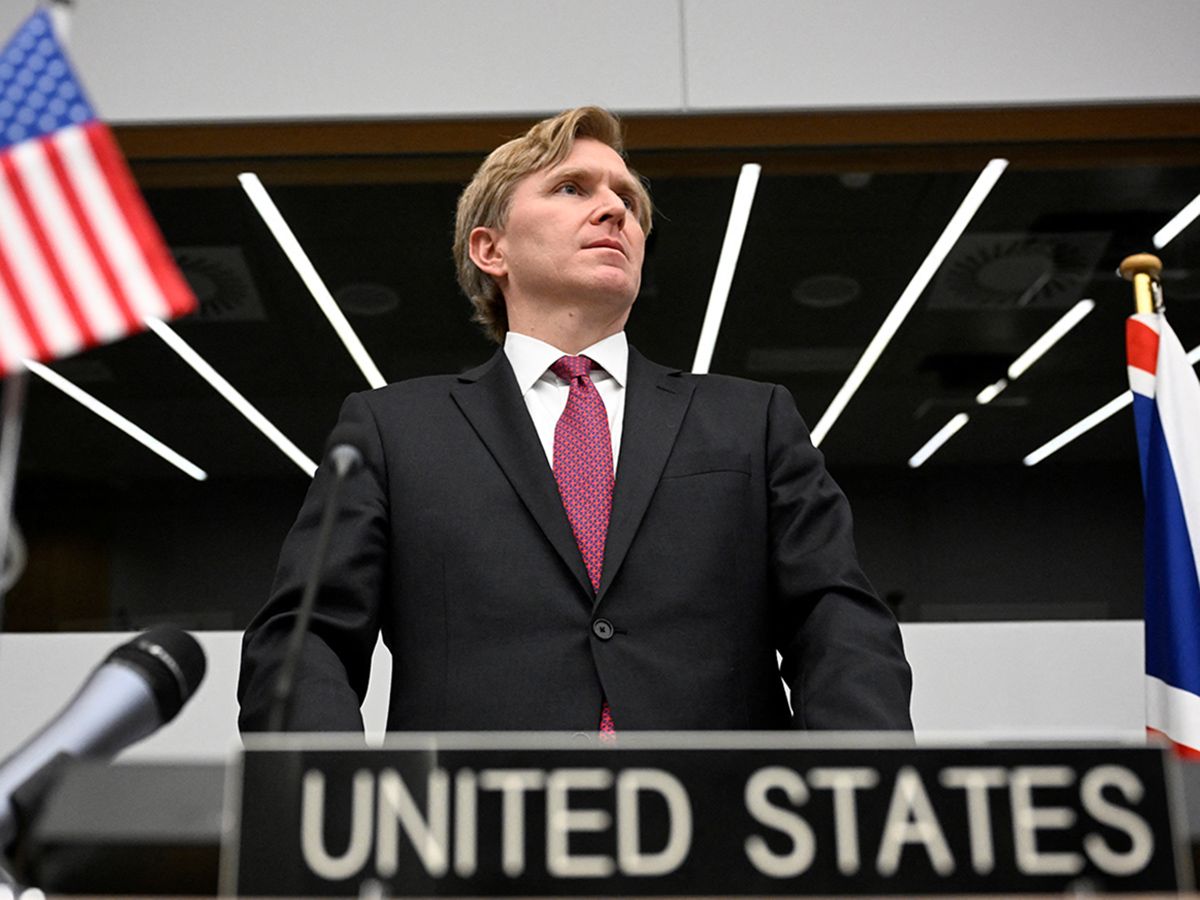
For someone who says he's unbothered by NATO allies pursuing a more autonomous path, the under secretary of war sounds awfully anxious
For many years, Elbridge Colby has been one of the loudest voices in Washington calling for America’s NATO allies to pay their “fair share” on defence, in order to allow the United States to pivot toward the growing challenge of China. It was something of a surprise, then, to see Colby, President Donald Trump’s “Under Secretary of War,” attacking those same allies on social media Tuesday for doing exactly what he has asked them to do for so long. Colby penned a lengthy thread on X dumping on the collective “middle power strategy” that the Europeans and Canada have been pursuing, while at the same time dismissing it as not a “serious possibility.”
“Rather, we are more concerned that a few allies and partners will think it is and waste valuable time, money and political capital on a distraction,” he wrote. The crux of the critique was the impact of the middle power strategy on America’s defence industry and arms sales. Colby said suggestions the U.S. would lose market share for its weaponry was “neither feasible nor accurate” since the U.S. makes the best equipment at a scale that no plausible competitor can match.
He said the White House welcomes allies’ investment in their own defence industries, “but in ways that are collaborative with America’s, rather than trying in vain to replicate it or supplant it.” For someone who says he is not bothered that his NATO allies are pursuing a more autonomous path, he sounded remarkably anxious. European NATO members have sourced around half their military equipment from the U.S. in recent years.
Clearly, that percentage is going to drop — and by the sounds of Colby’s transparent dissimulation, by quite a lot. “(I)f you feel you need to point all this out publicly, this suggests that you are correctly beginning to understand that many of your allies have lost trust in U.S. reliability,” replied Wolfgang Ischinger, chair of the Munich Security Conference and a former German ambassador in the U.S., to Colby’s post on X. Washington’s belated realization that the breach in relations President Trump has instituted will have economic consequences was first expressed by the U.S. deputy secretary of state, Christopher Landau, at a NATO foreign ministers’ meeting last December, when he warned partners against “bullying” U.S. firms out of European arms bids.
Presumably, he did not appreciate the irony of the Trump administration levelling accusations of protectionism. Yet, as any flexible realist would know, you cannot elevate military spending to the levels Colby is advocating without persuading voters that it is economically, as well as militarily, in the national interest. Prime Minister Mark Carney has promised to increase core military spending to 3.5 per cent of GDP by 2035 ($132 billion, in today’s dollars).
But in doing so, he said the share of defence acquisitions made in Canada will rise to nearer 70 per cent (from 30 per cent currently); that defence industry revenue will increase by 240 per cent and defence exports by 50 per cent; and that all this activity will create 125,000 jobs. We are already seeing the policy implications of the new defence industrial strategy. At the NATO meeting in Turkey earlier this month, Carney announced a military satellite deal with Canadian company Telesat, and a tender shortlist of two Canadian suppliers for up to 2,100 light utility vehicles.
Similar decisions are being taken all over the free world. The common denominator is Trump’s belief that America benefits from the uncertainty provoked by his equivocation on whether the U.S. will still honour NATO’s Article 5 stipulating that an attack on any ally is an attack on all. Colby wants Europe and Canada to spend more on defence and stop relying on American safety guarantees.
But he also wants all that increased spending to be on American weapons. Those two desires are incompatible. Despite the evidence to the contrary, he is a smart man and vastly experienced.
He must know that the crisis of trust that Trump has sparked means America has to accept its allies will work to reduce their dependence on Washington. That has not happened yet, but the bloc is moving in that direction, accompanied by other allies. In January, Canada joined the European Union’s Security Action for Europe (SAFE), a $240-billion defence rearmament and procurement initiative.
Colby protested that a middle-power strategy does not have a coherent geographic, economic or military basis for alignment. And yet it exists. Trump’s power is waning, not waxing.
Sixty per cent of Americans disapprove of his performance, and predictive markets suggest the Democrats will likely take the Senate and the House in the midterm elections later this year. But trust is hard to earn and is easily burned. It will be a very long time before any of America’s major allies place their faith in security guarantees coming out of the White House, whomever is president.
National Post
- Published
- Jul 16, 2026
- Updated
- Jul 16, 2026
- Source
- National Post
- Category
- Politics
- Read time
- 4 min
Key facts
Why this matters locally
This politics story matters locally because it may affect readers, businesses, commuters, families, or public services in British Columbia.
Local impact
BC Post links this item to British Columbia coverage so readers can follow related city updates, weather, traffic, events, and category news in one place.
Timeline
Source and credit
BC Post may summarize, organize, and add local context for reader clarity. Original reporting remains with the listed publisher.
Related Articles
View all Politics
Powerful pro-life ad featuring boxing legend to air during final World Cup matches
Politics
Powerful pro-life ad featuring boxing legend to air during final World Cup matches
 Politics
Vaughn Palmer: David Eby's slow and expensive step toward involuntary care
Politics
Vaughn Palmer: David Eby's slow and expensive step toward involuntary care
 Politics
Pitt Meadows to host information session for city council candidates
Politics
Pitt Meadows to host information session for city council candidates
 Politics
Corus rebuts misinformation about future of Global News in Alberta after layoffs
Politics
Corus rebuts misinformation about future of Global News in Alberta after layoffs
 Politics
‘No consequences’: East Van woman says she was targeted by hate-motivated assault
Politics
‘No consequences’: East Van woman says she was targeted by hate-motivated assault
 Politics
Hundreds of enthusiatic supporters attend Surrey Mayor Brenda Locke’s fundarising dinner
Politics
Hundreds of enthusiatic supporters attend Surrey Mayor Brenda Locke’s fundarising dinner
More Local Coverage
Latest news Business
AI Market Trends: Q2 2026 Review and Forecast
Business
AI Market Trends: Q2 2026 Review and Forecast
 Local News
Cowichan sports shorts: rugby, hockey, biking
Local News
Cowichan sports shorts: rugby, hockey, biking