

ICICI Prudential Q1 FY2027 slides: protection surge drives 25% VNB growth
U.S. futures hold on to gains after data shows producer prices cooled in June Introduction & Market Context ICICI Prudential Life Insurance presented its Q1-FY2027 performance update on July 15, 2026, revealing strong momentum driven by accelerating protection business and improved profitability. The company, trusted by over 20 crore Indians in its 25-year history, reported value of new business (VNB) growth of 24.9% year-over-year to ₹5.71 billion, with VNB margin expanding to 26.7% from 24.7% in the full prior fiscal year. The market responded positively to the results, with shares rising 4.21% to $525.15 following the announcement, reflecting investor confidence in the company’s operating momentum and strategic execution.
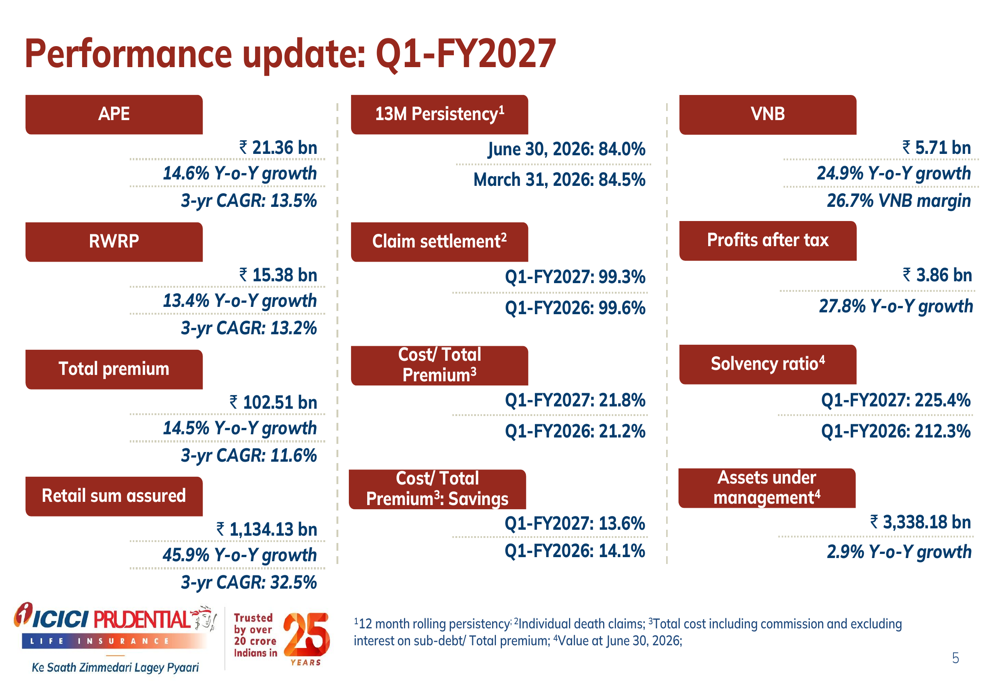
The stock now trades approximately 14.3% above its 52-week low of $459.50, though still below the 52-week high of $706.80. Quarterly Performance Highlights The company’s first quarter demonstrated broad-based strength across key financial metrics. As detailed in the comprehensive performance overview, ICICI Prudential achieved double-digit growth in most major categories while maintaining strong operational ratios.
Annualized Premium Equivalent (APE) reached ₹21.36 billion, representing 14.6% year-over-year growth and a three-year compound annual growth rate of 13.5%. Total premium grew 14.5% to ₹102.51 billion, while profit after tax surged 27.8% to ₹3.86 billion, demonstrating improved profitability alongside revenue expansion. The company maintained robust operational metrics, with individual death claim settlement at 99.3% and a solvency ratio of 225.4%—well above the regulatory requirement of 150%.
The 13-month persistency ratio stood at 84.0%, reflecting strong customer retention. Assets under management reached ₹3,338.18 billion as of June 30, 2026. Protection Business Drives Growth
The quarter’s standout performance came from the protection segment, which management and analysts identified as the primary driver of VNB growth and margin expansion. The following breakdown illustrates the dramatic shift in product mix and growth rates across segments. Protection APE jumped 45.7% year-over-year to ₹5.96 billion, with retail protection growing an even more impressive 60.4% to ₹2.23 billion.
This acceleration benefited from the GST exemption on term insurance as well as strategic product and distribution initiatives. The protection segment’s mix of total APE increased from 21.9% to 27.9%, reflecting a meaningful shift toward higher-margin business. In contrast, the savings segment showed more modest growth of 5.8%, reaching ₹15.40 billion, as customers continued to favor fixed deposits and other alternatives in the current interest rate environment.
Within savings, linked products grew 6.4% while non-linked products declined 9.5%, indicating selective customer preferences. The annuity and group funds segments also posted strong gains, with annuity APE rising 33.0% and group funds increasing 42.2%, albeit from smaller bases. The protection business’s strength extended to sum assured metrics, with new business retail sum assured growing 45.9% to ₹1,134.13 billion.
The company achieved a sum assured market share of 11.8% in Q1-FY2027, positioning it competitively in the growing protection market. Distribution Strategy & Channel Performance ICICI Prudential’s diversified distribution approach continued to demonstrate balanced growth across multiple channels. The company operates through five primary distribution channels: agency, direct, bancassurance, partnership distribution, and group.
The partnership distribution channel emerged as the fastest-growing segment, with APE surging 29.5% to ₹3.12 billion, increasing its mix from 12.9% to 14.6%. This growth reflects the company’s strategy to build what management calls the "most partnerable life insurance company," with over 1,500 partnerships including 25+ new partnerships added in Q1-FY2027 alone. The group channel posted the strongest absolute growth at 38.8%, reaching ₹4.90 billion and increasing its mix to 22.9%.
Retail APE across all channels grew 8.9% to ₹16.46 billion. The agency channel added approximately 15,000 advisors during the quarter, bringing the total to over 244,000 advisors. The following visual representation shows the well-balanced distribution mix, which management emphasized reduces dependence on any single channel.
Bancassurance, with access to over 26,800 bank branches across 52 banking partners, contributed 27% of total APE. The agency channel accounted for 22%, while direct distribution represented 13% of the mix. Management noted that no single distributor other than ICICI Bank accounts for a disproportionate share of business, providing strategic flexibility.
Each channel demonstrates distinct product preferences and strategic focus. The partnership distribution channel showed particularly strong performance in protection products, with a 41% protection and annuity mix. The direct channel, being analytics-driven, achieved a 46% protection and annuity mix while focusing on digital upsell campaigns.
Technology & Operational Excellence ICICI Prudential emphasized its technology-driven approach to operational efficiency and customer experience. The company reported approximately 27 million digital service interactions in Q1-FY2027, with 97.0% of service interactions occurring via self-help or digital modes. The company’s customer-centric metrics demonstrate the impact of digital transformation: approximately 58% of policies were issued using digital KYC in Q1-FY2027, and about 54% of savings policies were issued on the same day.
Claims settlement averaged just 1.0 day for non-investigated individual claims, with a best-in-class early claims ratio of 22%. These achievements earned ICICI Prudential recognition as "The Best Customer Oriented Company" by ICC Emerging Asia Insurance Awards in FY2026. The company’s mobile application has accumulated over 5.1 million downloads, and 99% of digital pages maintained system uptime above 99%.
The integration of artificial intelligence and analytics across the customer journey has generated measurable value. The following illustration shows how AI is embedded at each stage of the customer lifecycle. AI-driven initiatives have delivered approximately ₹900 million in savings through early claims detection at the onboarding stage, and about ₹1,100 million in savings through fraud detection in claims processing.
The company processes around 600,000 emails through automated classification, and generates 12,000 monthly personalized product recommendations through predictive models. Market Opportunity & Industry Context The presentation devoted considerable attention to the significant growth opportunity in India’s life insurance market, particularly in the protection segment.
India’s protection penetration remains substantially below global peers, creating a multi-decade growth runway. India’s sum assured as a percentage of GDP stands at just 27% for retail protection, dramatically lower than Singapore (332%), Japan (252%), USA (251%), Malaysia (153%), Thailand (143%), and South Korea (127%). Only 13% of the addressable population is covered by retail protection policies, and India faces a protection gap of 83%, representing approximately $16.5 trillion.
The demographic and economic backdrop supports sustained industry growth. India’s working-age population (25-59 years) is projected to grow from 679.6 million in FY2024 to 777.5 million by FY2034, a 14% increase. The country’s GDP growth is forecast at 6.7% for FY2027E, among the highest globally, while India demonstrated the strongest GDP per capita CAGR at 8.0% from FY2014 to FY2024.
The retirement opportunity is equally compelling, with pension assets at just 11% of GDP compared to 65% in Hong Kong, 146% in the USA, and 162% in Australia. India’s projected retirement savings gap is expected to widen from $8 billion in 2022 to $96 billion by 2050, with a CAGR of 9.6%. Retail credit growth, which creates demand for credit life insurance, expanded at a 17.4% CAGR from March 2016 to March 2026, reaching ₹69,398 billion.
The health insurance market also presents opportunities, with 30% of the population remaining uncovered by any health scheme. Strategic Initiatives & ESG Integration ICICI Prudential operates under a "3C Framework" comprising Customer centricity, Competency, and Catalyst, designed to deliver sustainable VNB growth by balancing business growth, profitability, and risk management. The framework is supported by investments in people, technology, and analytics.
The company’s people strategy showed strong results, with 77% of leadership positions held by individuals with more than 10 years of tenure, and 92% of leaders having completed more than three job rotations. Gender diversity stood at 30% of total employees, and the employee Net Promoter Score reached 81. ICICI Prudential’s ESG score from Stakeholders Empowerment Services improved to 78.9 in 2025 from 76.2 in 2024, positioning it as one of the highest-rated Indian life insurers according to leading global and Indian ESG rating agencies.
The company expanded renewable energy usage to 64 offices in FY2026, up from 59 in FY2025. The Board announced a proposal to rename the company as "ICICI Life Insurance Limited," pending regulatory approval. This follows the Board’s approval of Prudential Corporation Holdings Limited’s request to reclassify its status from "Promoter" to "Investor."
Management emphasized that core business operations, strategy, and governance frameworks remain unchanged. Financial Value Creation The company’s embedded value metrics demonstrated strong value creation during the period.
The following chart illustrates the movement in VNB margin and embedded value. VNB margin expanded from 22.8% in FY2025 to 24.7% in FY2026, driven by a 3.4 percentage point contribution from changes in new business profile and a 2.5 percentage point contribution from economic assumptions, partially offset by a 3.9 percentage point reduction from operating assumptions changes. Total embedded value grew 10.5% from ₹479.51 billion at March 31, 2025, to ₹529.89 billion at March 31, 2026.
The value of in-force business increased 10.1% to ₹396.64 billion, while adjusted net worth rose to ₹133.25 billion. The return on embedded value reached 11.9% for the period. Forward-Looking Perspective Management provided measured guidance for the remainder of the fiscal year, emphasizing a focus on absolute VNB growth rather than fixed margin targets.
Chief Financial Officer Dhiren stated during the earnings call: "Margin is not a fixation for us. It’s growth in absolute VNB that we will continue to focus on." The company expects retail protection growth to remain strong, though likely moderating from the exceptionally high first-quarter pace as comparisons become more challenging in the second half.
The microfinance segment may see further recovery, while savings business performance will continue to depend on the competitive environment, particularly fixed deposit rates. Management anticipates annuity to remain a growth area with potential for double-digit expansion, and expects continued investment in AI and machine learning to support efficiency and underwriting capabilities. The solvency ratio is expected to remain comfortably above regulatory minimums.
Managing Director and CEO Anup Bagchi emphasized the company’s long-term orientation: "We remain well-positioned to drive sustainable growth, enhance customer outcomes, and create long-term value for stakeholders." However, the company faces several near-term challenges, including potential slowdown in protection growth due to tougher comparisons, continued pressure on savings business from competing products, higher operating expenses due to unavailability of input tax credit, and potential AUM volatility as policies exit lock-in periods. With a strong first quarter performance, diversified distribution platform, significant market opportunity in under-penetrated segments, and continued technology investments, ICICI Prudential appears positioned to sustain growth momentum while navigating a competitive and evolving market landscape.
Full presentation:
- Published
- Jul 15, 2026
- Updated
- Jul 15, 2026
- Source
- Investing Canada
- Category
- Business
- Read time
- 8 min
Key facts
Why this matters locally
This business story matters locally because it may affect readers, businesses, commuters, families, or public services in British Columbia.
Local impact
BC Post links this item to British Columbia coverage so readers can follow related city updates, weather, traffic, events, and category news in one place.
Timeline
Source and credit
BC Post may summarize, organize, and add local context for reader clarity. Original reporting remains with the listed publisher.
Related Articles
View all Business
AI Market Trends: Q2 2026 Review and Forecast
Business
AI Market Trends: Q2 2026 Review and Forecast
 Business
Starchuk seeking judicial review of Surrey arena land-swap
Business
Starchuk seeking judicial review of Surrey arena land-swap
 Business
B.C.'s Massey Tunnel replacement doubles in cost to estimated $8.5 billion
Business
B.C.'s Massey Tunnel replacement doubles in cost to estimated $8.5 billion
 Business
This is the design of Coquitlam's new aquatic and community centre on the Fraser River
Business
This is the design of Coquitlam's new aquatic and community centre on the Fraser River
More Local Coverage
Latest news Politics
Powerful pro-life ad featuring boxing legend to air during final World Cup matches
Politics
Powerful pro-life ad featuring boxing legend to air during final World Cup matches
 Local News
Cowichan sports shorts: rugby, hockey, biking
Local News
Cowichan sports shorts: rugby, hockey, biking