

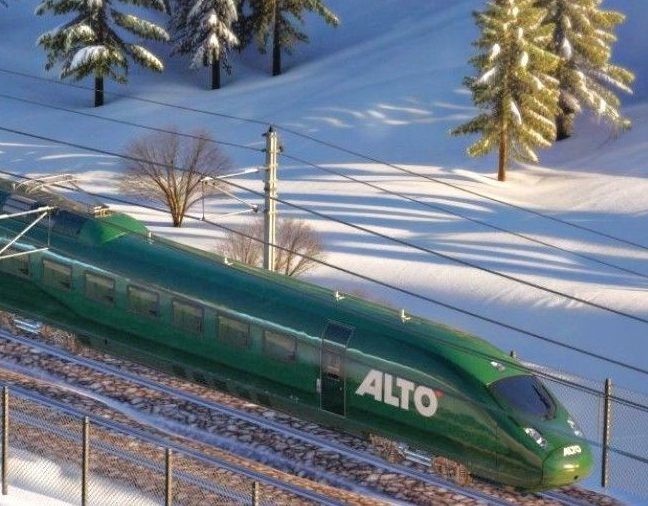
Alto is advancing the development of Canada's first high-speed rail network, and projects of this scale raise legitimate questions.
Article content Alto is advancing the development of Canada’s first high-speed rail network, and projects of this scale raise legitimate questions about land, property owners and local impacts. That is why Alto began by identifying a broad study corridor and consulting early, rather than presenting a final alignment. Before an alignment can be identified, environmental considerations, engineering requirements, agricultural impacts, Indigenous consultation, existing infrastructure, community feedback and safety standards all need to be carefully assessed.
We chose this approach because decisions of this magnitude should be informed not only by our own technical work, but also by meaningful input from communities, stakeholders and the public. Recommended Videos Communities across Eastern Ontario have long relied on passenger rail connections. This is one of the reasons Alto is evaluating the potential for a station in Kingston and the role it could play as a mobility hub for the region.
But the conversation about high-speed rail is about more than choosing an alignment. It is also about how a project of this scale approaches land acquisition, communities, and the people who may be affected by it. Alto’s focus is on delivering a high-speed rail network that will serve Canadians for generations.
Property will only be required to support the construction, operation, or maintenance of the network. Alto is not acquiring land for purposes unrelated to that objective. Just as importantly, property owners deserve to be treated fairly and respectfully.
Our objective is to reach negotiated agreements wherever possible and ensure fair compensation that reflects the specific circumstances of each property. Our approach prioritizes negotiated agreements and recognizes that the impacts of a project like this often extend beyond the land itself, including impacts on homeowners, businesses, and agricultural operations. If expropriation is required, it would be carried out by the appropriate authorities according to applicable laws and regulations.
Every property is different, and every situation deserves to be considered carefully. That is why Alto is committed to implementing a personalized approach for each impacted landowner. High-speed rail represents a generational opportunity to improve mobility in Canada’s most populated region.
As planning progresses, our focus remains on delivering that vision responsibly and in partnership with the communities along the corridor, while minimizing impacts and treating property owners fairly and respectfully. Pierre-Yves Boivin, Chief Communications and Engagement Officer, Alto
- Published
- Jul 16, 2026
- Updated
- Jul 16, 2026
- Source
- The Kingston Whig Standard
- Category
- Business
- Read time
- 2 min
Key facts
Why this matters locally
This business story matters locally because it may affect readers, businesses, commuters, families, or public services in British Columbia.
Local impact
BC Post links this item to British Columbia coverage so readers can follow related city updates, weather, traffic, events, and category news in one place.
Timeline
Source and credit
BC Post may summarize, organize, and add local context for reader clarity. Original reporting remains with the listed publisher.
Related Articles
View all Business
AI Market Trends: Q2 2026 Review and Forecast
Business
AI Market Trends: Q2 2026 Review and Forecast
 Business
Starchuk seeking judicial review of Surrey arena land-swap
Business
Starchuk seeking judicial review of Surrey arena land-swap
 Business
B.C.'s Massey Tunnel replacement doubles in cost to estimated $8.5 billion
Business
B.C.'s Massey Tunnel replacement doubles in cost to estimated $8.5 billion
 Business
Earth Angel Worldwide Expands Its Mission Through Music, Education and Environmental Stewardship
Business
Earth Angel Worldwide Expands Its Mission Through Music, Education and Environmental Stewardship
More Local Coverage
Latest news Politics
Powerful pro-life ad featuring boxing legend to air during final World Cup matches
Politics
Powerful pro-life ad featuring boxing legend to air during final World Cup matches
 Local News
Cowichan sports shorts: rugby, hockey, biking
Local News
Cowichan sports shorts: rugby, hockey, biking